mobile menu button

1997-2006

Life of Buddhism

1997 (Age 71)

1998 (Age 72)

1999 (Age 73)

2000 (Age 74)

2001 (Age 75)

2002 (Age 76)

2003 (Age 77)

2004 (Age 78)

2005 (Age 79)

2006 (Age 80)

1997

Founding "Gandha Samudra Culture Company"

"Gandha Samudra" means "gathering of book fragrance, wisdom like the ocean." Its main purpose is to serve as a bridge between Buddhist culture and society. Publishing Buddhist books, audio-visual releases, and cultural artifact distribution, through Gandha Samudra's wide circulation, the general public can encounter Buddhism.

1997

Establishing Voice of Ganges Co., Ltd

Named "Voice of Ganges" (Thus Have I Heard), hoping to take Venerable Ananda's mission of transmitting the true Dharma as spiritual guidance, transmitting and producing quality music, and using beautiful music to purify society and improve body and mind.

February 28, 1997

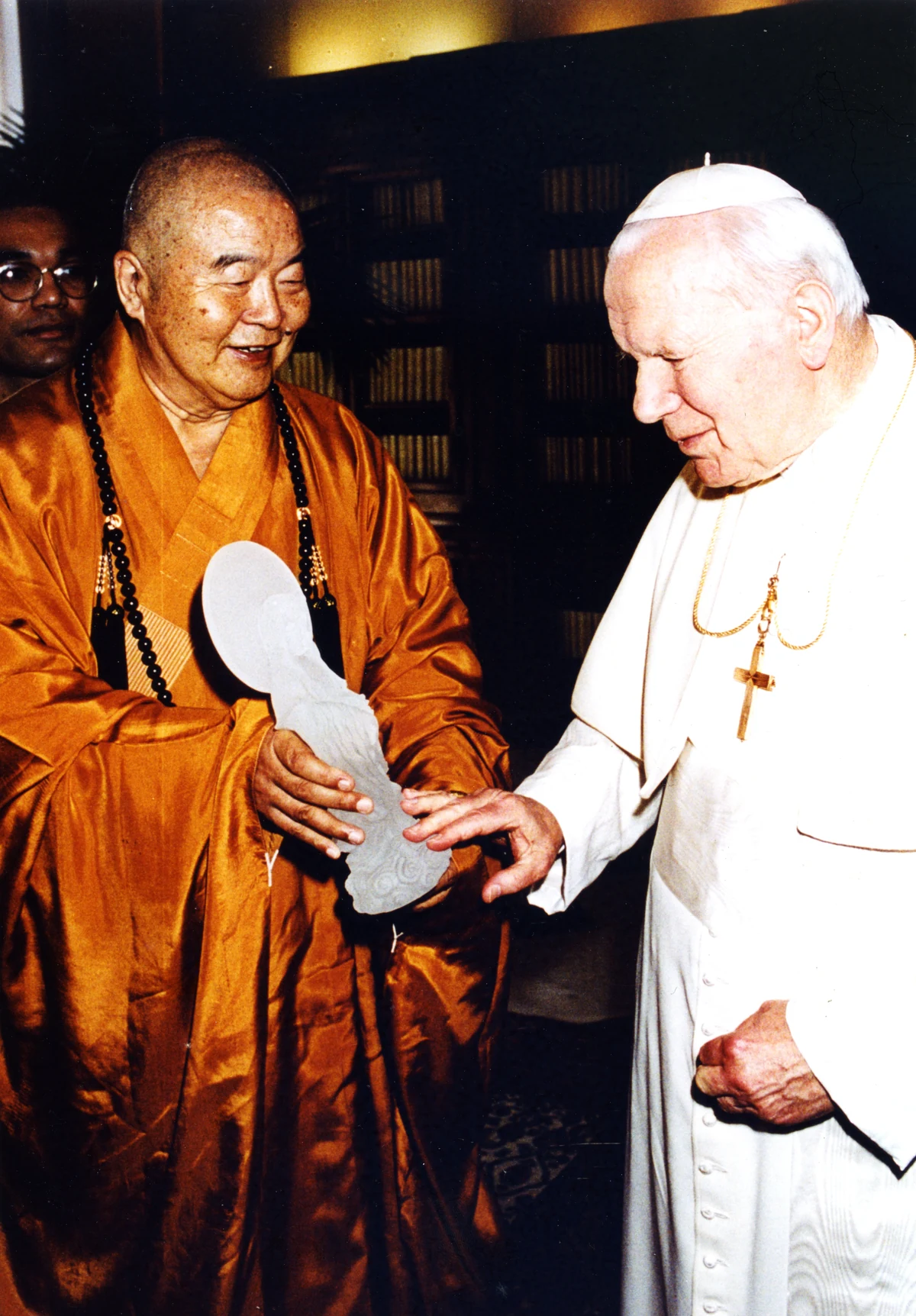
Invited to Vatican, Italy for Historic Religious Dialogue with Pope John Paul II

On February 28, 1997, Venerable Master Hsing Yun represented Buddhism at the Vatican for dialogue with Pope John Paul II. Venerable Master proposed five suggestions for Catholic-Buddhist exchange, which received the Pope's approval and support.

Media called this dialogue "a forward-looking and constructive religious dialogue across centuries," symbolizing the two great religious organizations of East and West jointly taking the first historic step toward religious harmony and world peace. The direction of human progress today primarily requires religious dialogue, communication, and exchange; with correct understanding of faith, humanity can collectively grow and develop spiritual awareness. Looking toward the 21st century, it will be an era emphasizing spiritual civilization and inner life.

May 12, 1997

Fo Guang Shan Holds First "Fo Guang Studies Academic Conference"

On May 12, 1997, celebrating Fo Guang Shan's 30th anniversary, the "Fo Guang Studies Academic Conference" was held, with the first lecture on "Fo Guang Studies" (or Buddha's Light Philosophy).

At the opening ceremony, Venerable Master Hsing Yun explained what Fo Guang Studies is: "Fo Guang Studies" is the modern Buddhism that everyone has collectively created over thirty years, integrating ancient and contemporary. Its content, meaning, spirit, and methods, both large and small, merge tradition with modernity, all worthy of deep contemplation and research. All Buddha-Dharma is Fo Guang Studies; everything in the world possessing ultimate truth, goodness, and beauty is encompassed within Fo Guang Studies.

May 16, 1997

After 30 years Since Founding, Implementing the "Sealing of the Mountain"

Having reached its 30th anniversary, Fo Guang Shan implemented the "Sealing of the Mountain" starting May 16, 1997, to strengthen disciples' intensive practice and education and replenish deep resources for Dharma propagation.

Venerable Master Hsing Yun explained that Sealing of the Mountain is not isolation but the beginning of another starting point, like monastics' closed retreat in the past, Sealing of the Mountain is a collective retreat. From a long-term perspective, it is indeed more beneficial for the human world and beings. At the Sealing of the Mountain ceremony, four verses arose in his mind: "Sealing of the Mountain, Sealing of the Mountain, the monastery's responsibility on one's shoulders; Sealing of the Mountain, Sealing of the Mountain, compassionate vows never close; Sealing of the Mountain, Sealing of the Mountain, bodhi flowers and fruits planted everywhere; Sealing of the Mountain, Sealing of the Mountain, propagating Dharma and benefiting beings, everyone join in.

Sealing of the Mountain also means "closing the person from going out, closing the mind from disturbance, closing affairs from grasping at conditions, closing emotions so they can be released," not only the cultivation Buddhists should have but also the mental purification society hopes for.

May 16, 1997

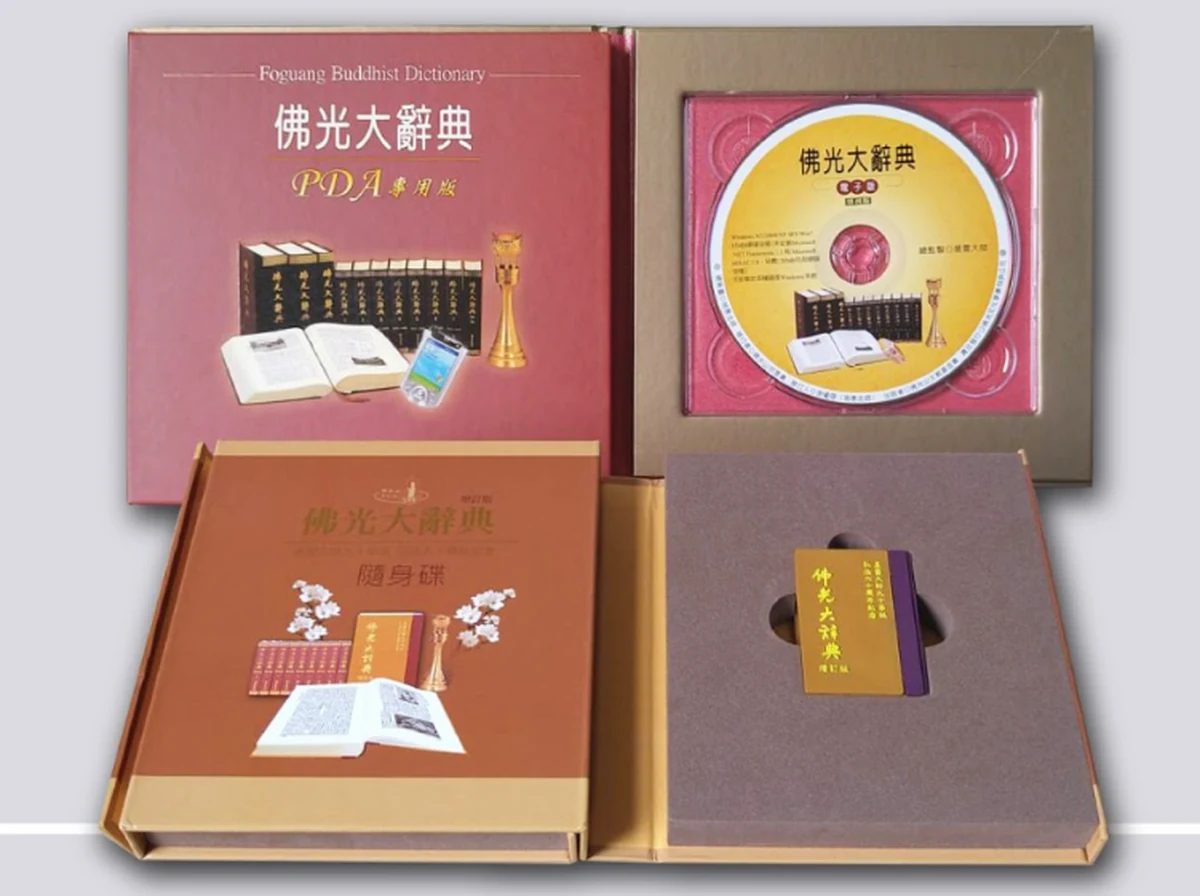
Fo Guang Shan's First "Electronic Buddhist Canon": Fo Guang Dictionary of Buddhism CD-ROM Published

When the Fo Guang Dictionary of Buddhism was published in 1988, it received widespread recognition and response. To enhance Buddha-Dharma transmission and keep pace with world trends, Venerable Master Hsing Yun proposed the concept of "computerizing the Tripitaka." After years of planning, in 1997 the Fo Guang Dictionary of Buddhism electronic edition was officially released, becoming the world's first modern Chinese Buddhist dictionary CD-ROM.

May 25, 1997

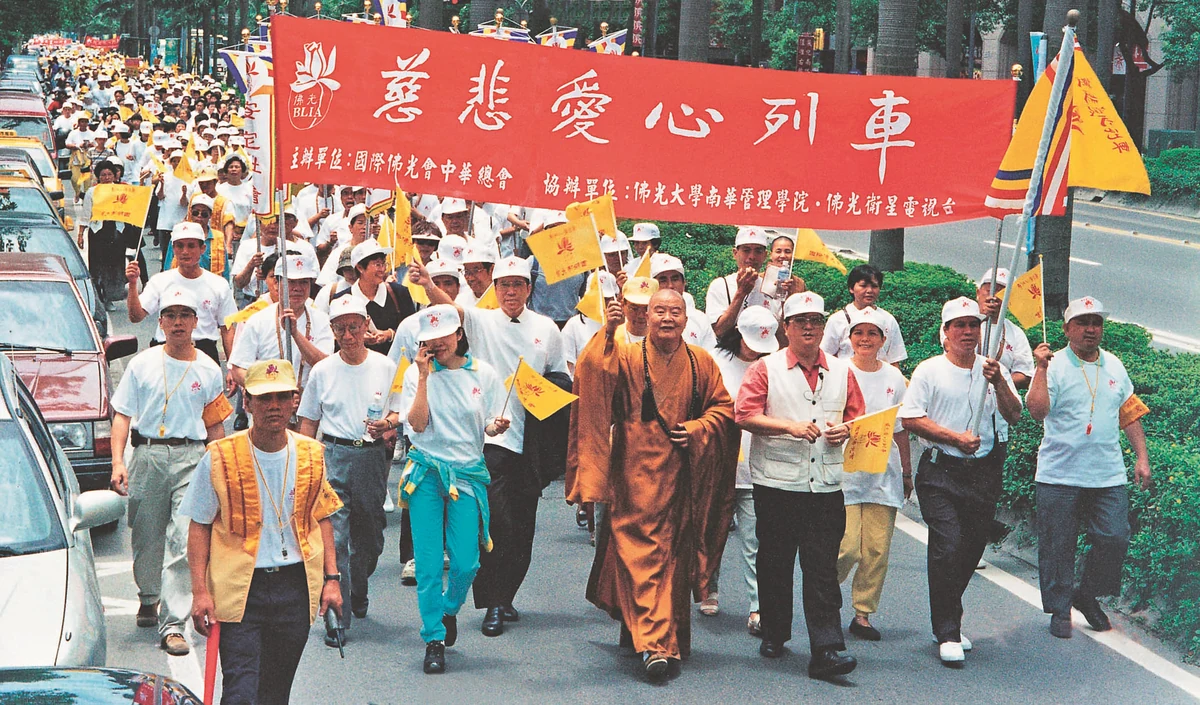
"Compassion and Loving-Kindness Campaign": 80,000 People Pledge to Become "Compassion and Loving-Kindness People"

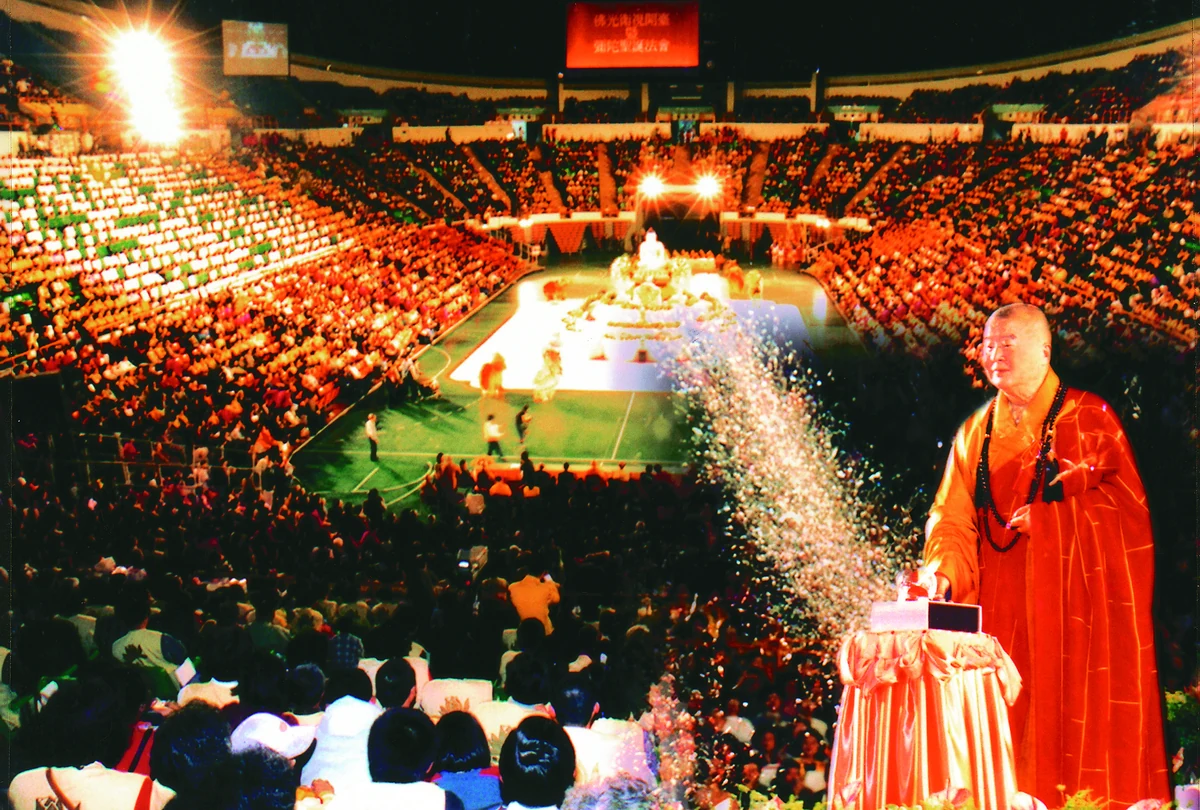
Fo Guang Shan and Buddha's Light International Association initiated the "Compassion and Loving-Kindness Campaign." 80,000 people pledged at National Chiang Kai-Shek Memorial Hall to become "Compassion and Loving-Kindness People," with Venerable Master Hsing Yun personally presiding.

To stabilize society and minds, on May 25, 1997, the "Compassion and Loving-Kindness Campaign" activity series was held, promoting "mental purification, moral reconstruction, recovering conscience, stabilizing society." After the assembly concluded, 2,000 Compassion and Loving-Kindness People advocates, carrying Compassion and Loving-Kindness banners, sang the Compassion and Loving-Kindness People song, "The time has come for mental purification, reconstructing morals to prosper their homes, recovering conscience without boasting, stabilizing society with love for China," promoting the Seven Admonitions, eliminating Ten Unwholesome Deeds, and doing one good deed daily, practicing compassion and love through action, leading society toward stability and happiness.

December 14, 1997

Fo Guang Satellite Television (now Beautiful Life Television) Holds Launch Ceremony at Linkou Arena

On December 14, 1997, Fo Guang Satellite Television (now Beautiful Life Television) held its launch ceremony at Linkou Arena, officially beginning broadcasts on New Year's Day the following year. Venerable Master Hsing Yun hoped to spread harmony and joy to the human world through this medium.

Fo Guang Satellite Television pioneered domestic television programming without commercial interruptions, producing programs on Buddhism, art, humanities, history, youth, women, and social education, creating a fresh television pure land in the modern audio-visual world.

In its first year, it won the 34th Television Golden Bell Awards for "Best Editing" and "Best Cultural Program Host," the only cable satellite station to receive awards. In October 2002, with the vision of "youthfulness, education, internationalization, and public welfare," it was renamed "Beautiful Life Television," hoping to realize Humanistic Buddhism's spirit.

January 6, 1998

Fo Guang Shan "Cloud Dwelling Building" Completed and Opened

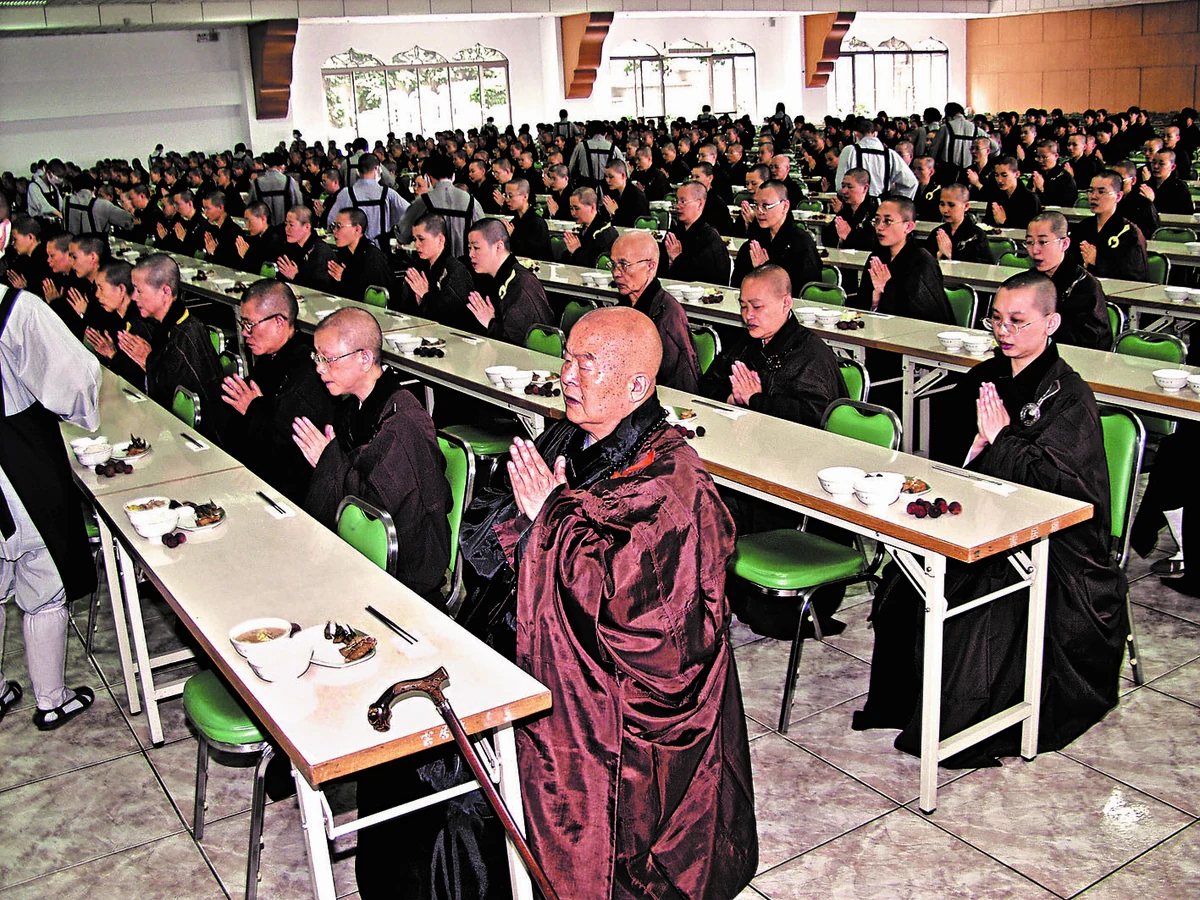
On January 6, 1998, through Venerable Master Hsing Yun's vow-power and wisdom, Fo Guang Shan's Cloud Dwelling Building was completed and opened. Nearly 1,000 monastics and laypeople used the dining hall for the first time. Cloud Dwelling Building has the most modern hardware facilities; one function is to demonstrate traditional "formal dining" etiquette, the best embodiment of "integrating tradition with modernity."

Cloud Dwelling Building's dining hall can accommodate nearly 3,000 people dining simultaneously. In over a thousand ping of space, not a single pillar is visible, unprecedented in traditional Buddhist temples and rare even in modern international-class architecture.

Every building at Fo Guang Shan was planned and designed by Venerable Master personally with architects, containing Venerable Master's propagation concepts and wisdom, worthy of study as "architecture." Venerable Master advocates "using facilities to replace manpower."

February 15-23, 1998

Transmitting "International Triple Platform Full Ordination" in India, Restoring Theravada Bhiksuni Order

From February 15–23, 1998, Venerable Master Hsing Yun and Buddhist leaders jointly initiated the "International Triple Platform Full Ordination" at Bodh Gaya, India, aiming to restore the Indian and Theravada bhiksuni order. Over 150 precept seekers from 23 countries participated, the first ordination session in Buddhism crossing ethnicity, region, and lineage transmission.

Transmitting the International Triple Platform Full Ordination at Bodh Gaya, the sacred site of Buddha's enlightenment, restored the Theravada bhiksuni order, promoting the Theravada bhiksuni order's return to the flourishing of Buddha's time, restoring the completeness of both male and female monastic orders' transmission, making Buddhism more complete and perfect, Buddhism's contribution to world peace.

April 7, 1998

Leading Delegation on Chartered Flight to Welcome Buddha's Tooth Relic to Taiwan for Veneration

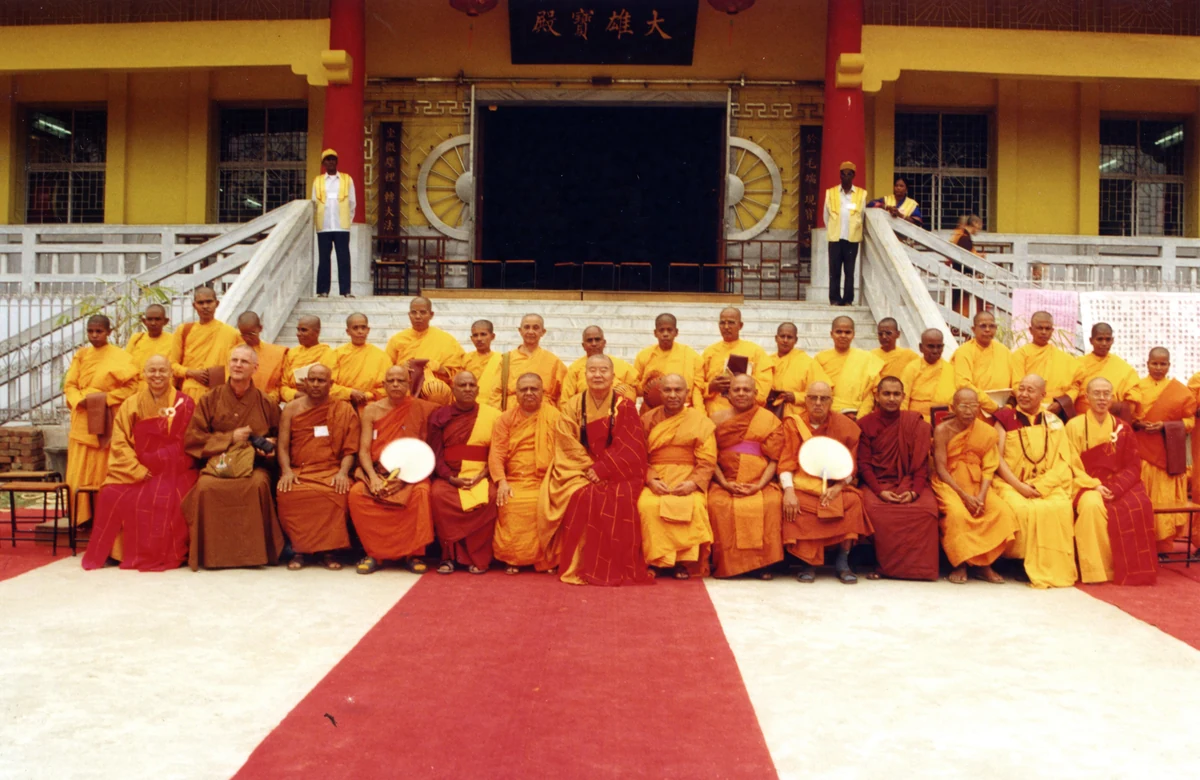
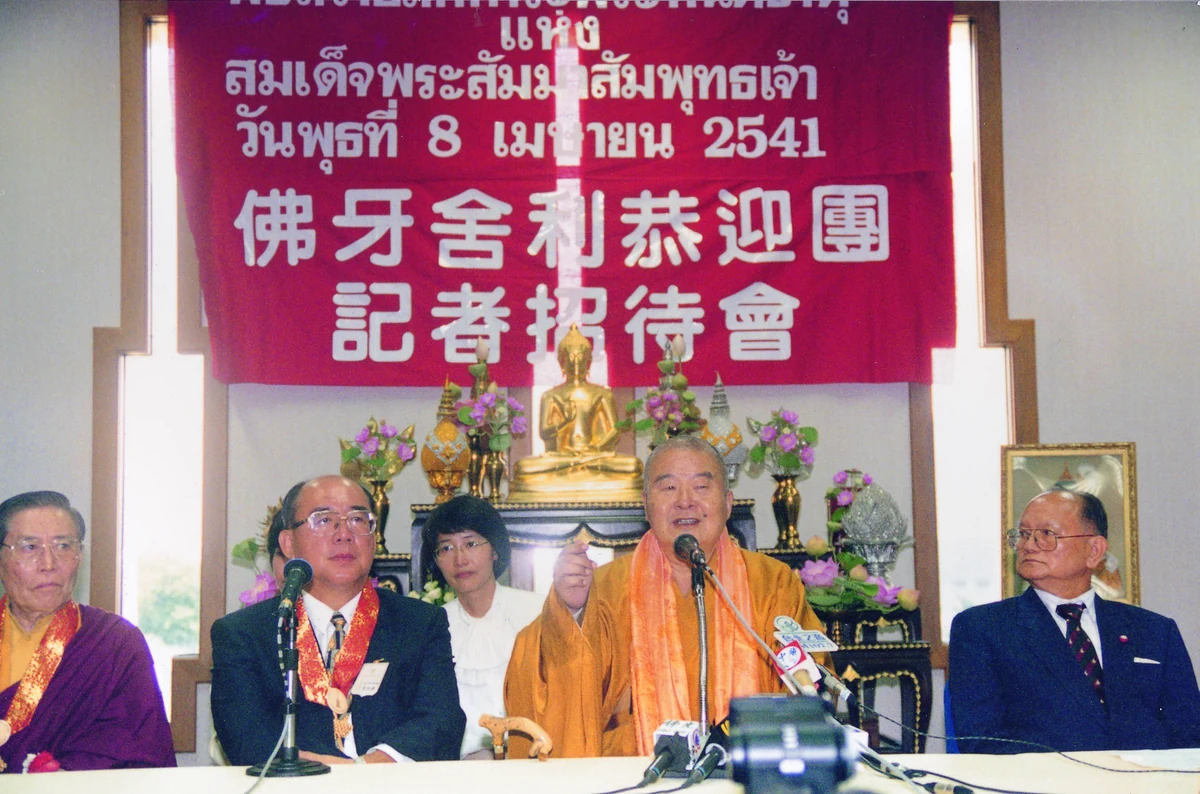
In February 1998, feeling that Theravada bhiksuni precepts had been lost for so long, Venerable Master Hsing Yun specially went to Bodh Gaya, India to transmit the "International Triple Platform Full Ordination," restoring Theravada bhiksuni precepts, while also accomplishing another grand event: Tibetan Lama Rinpoche Kunga Dorje presented a Buddha tooth relic he had protected for many years to Venerable Master, hoping he would bring it back to Taiwan, build a hall for veneration, preserving true Dharma and restoring the relic's radiance. Wu Po-hsiung as delegation leader and Venerable Tzu Jung as executive director, forming the "Buddha's Tooth Relic Welcoming Delegation," taking China Airlines chartered flight CI-695 to Thailand on April 7 to welcome the Buddha tooth.

Venerable Master united Buddhist leaders and social luminaries. Wu Po-hsiung as delegation leader and Venerable Tzu Jung as executive director, joined by Venerable Hsin Ting, Venerable Tzu Chuang, Venerable Tzu Hui, as well as Wang Jin-pyng, Chen Li-an, Wu Den-yih, Ting Shou-chung, Tina Pan, Nancy Chao, and over a hundred other Buddhist leaders and social luminaries, they formed the "Buddha Tooth Relic Welcoming Delegation. On April 7, they took China Airlines chartered flight CI-695 to Thailand to welcome the Buddha tooth.

April 11, 1998

Holding "Welcoming the Buddha's Tooth Relic: Sutric and Tantric Dharma Service for the Protection and Peace of the Country"; Venerable Master Initiates "Three Acts of Goodness Campaign"

On April 11, 1998, Fo Guang Shan held the "Welcoming the Buddha's Tooth Relic: Sutric and Tantric Dharma Service for the Protection and Peace of the Country" at the National Chiang Kai-Shek Memorial Hall plaza. At the assembly, Venerable Master Hsing Yun initiated the "Three Acts of Goodness Campaign," receiving Vice President Lien Chan's endorsement and leading over 100,000 attendees in jointly pledging to practice it.

The Three Acts of Goodness Campaign for purifying minds: do good deeds, speak good words, think good thoughts, using the Three Acts of Goodness to eliminate the three poisons, transforming violence into harmony, jealousy into praise, greed into joyful giving, and turbid evil into purity. Hoping everyone practices the Three Acts of Goodness, through purifying body, speech, and mind karma, making society filled with infinite beauty.

May 5, 1998

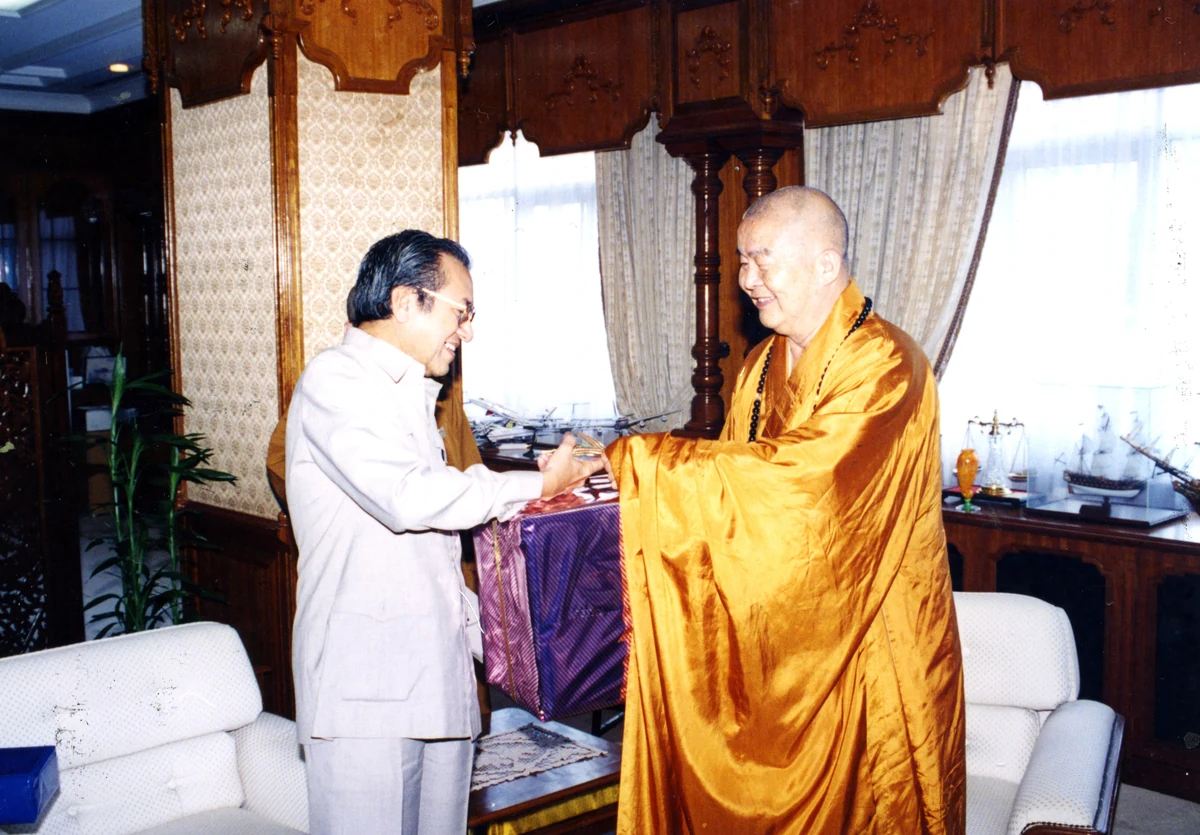
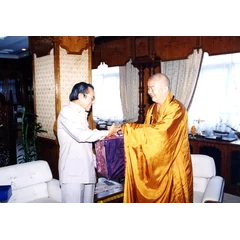
Meeting with Malaysian Prime Minister Mahathir Mohamad

Venerable Master Hsing Yun met with Malaysian Prime Minister Mahathir Mohamad. Since taking office, the Muslim-faith Mahathir received an international Buddhist leader at the Prime Minister's Office for the first time.
May 1999

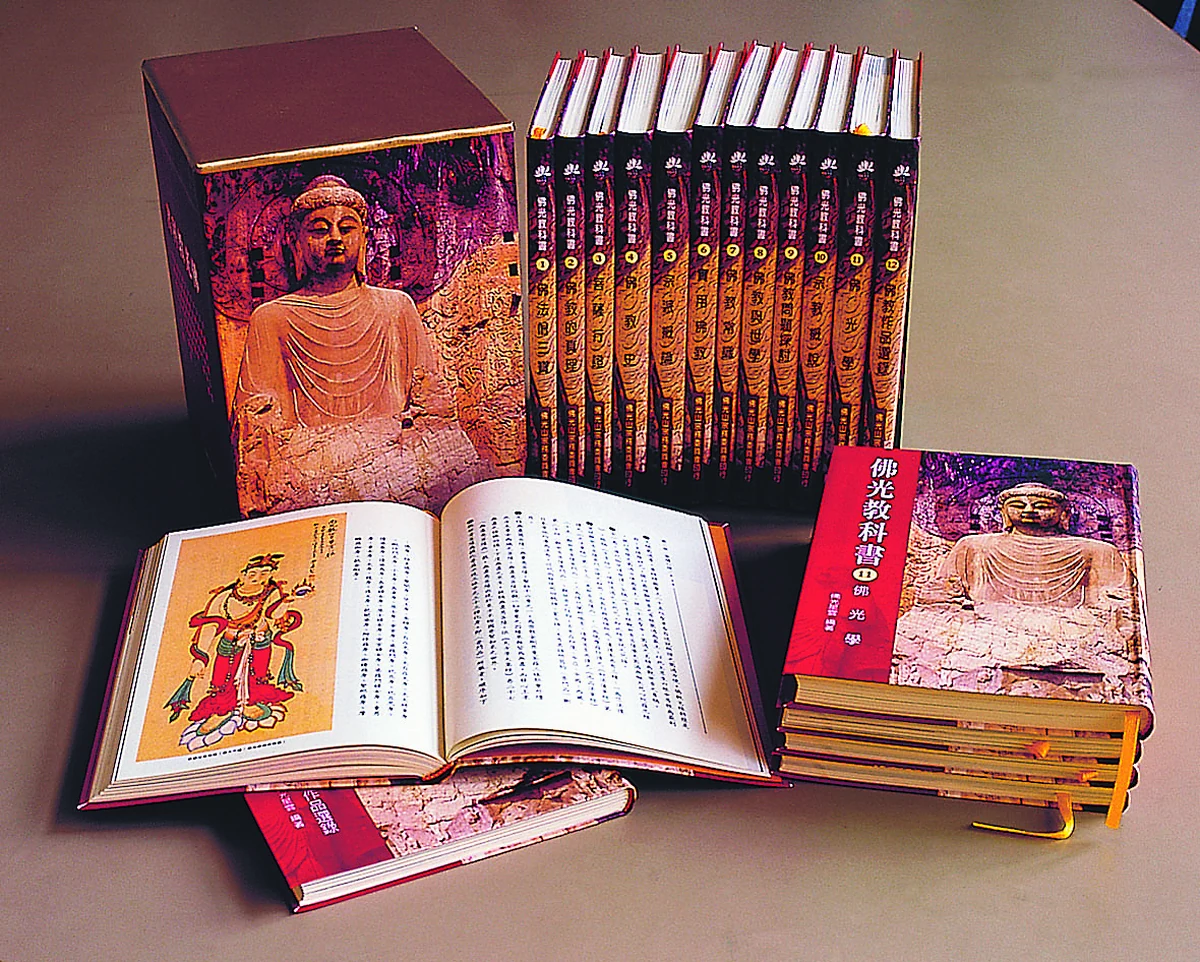
Publication of Fo Guang Essential Guides to Buddhism Edited by Venerable Master Hsing Yun

Venerable Master Hsing Yun believed Buddhism needs modernization; what modern Buddhism lacks most importantly is a complete set of Buddhist textbooks. After half a century of contemplation, edited by Venerable Master, it was compiled and published on the eve of Buddhism's 2,000th anniversary of eastward transmission to China.

Venerable Master stated he hoped Fo Guang Essential Guides to Buddhism could be used by masters teaching disciples in Buddhism and as textbooks for teachers at Buddhist academies, widely applied in training sessions and reading groups organized by temple organizations, providing those interested in Buddhist research with introductory reference material.

July 1999

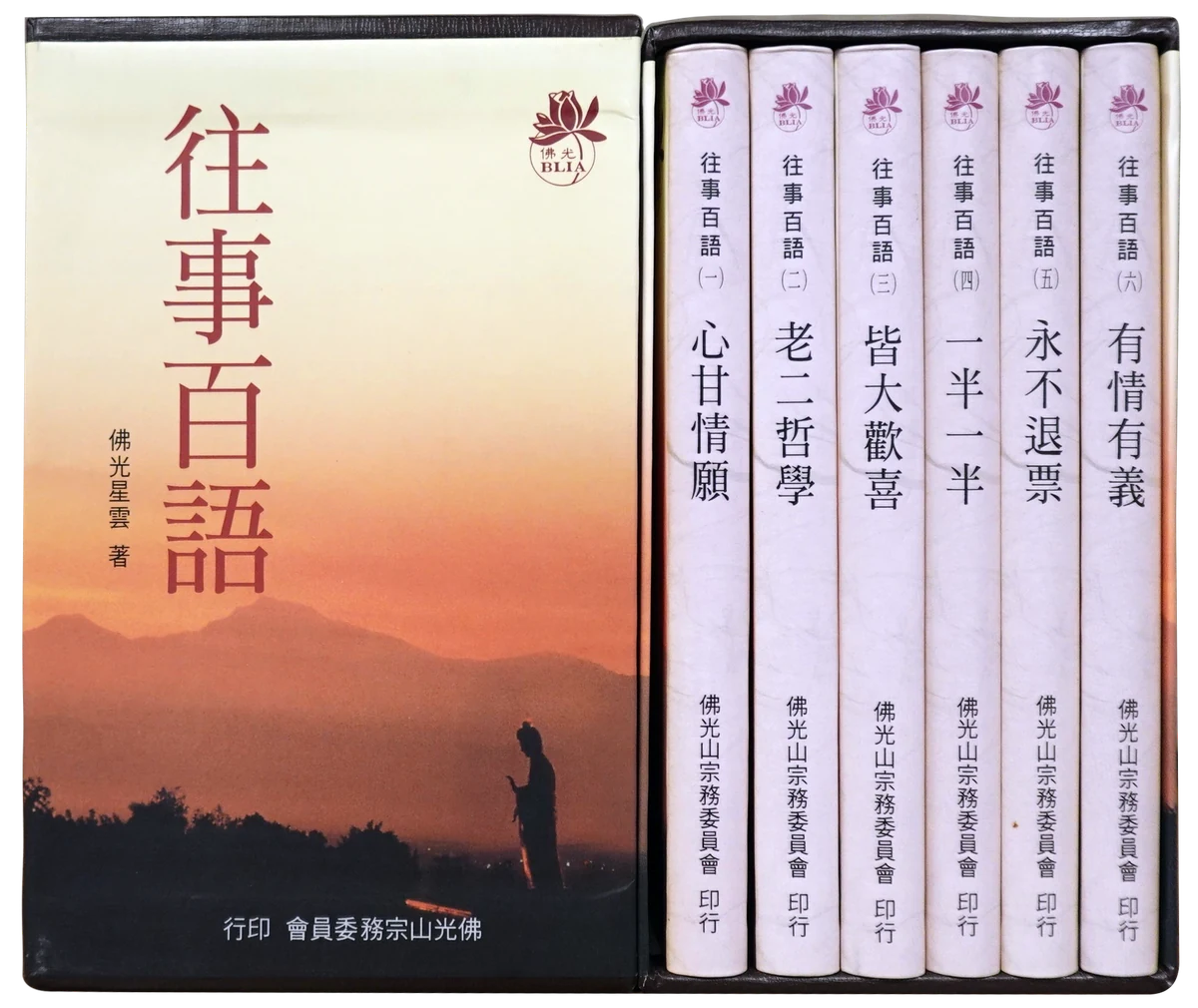
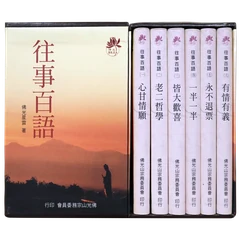
Publication of the Hsing Yun's Hundred Saying Series

Venerable Master Hsing Yun said people often ask: "Please give him a saying as a motto?" Always fulfilling people's wishes, throughout his life he has given countless people countless "sayings." Venerable Master felt: giving someone "a saying" is easy; how to make it useful to them is most important.

Reflecting on his life's many twists and turns, continuous hardships, there are indeed many "one saying" stories worth serving as inspirational reference for modern youth. Thus starting July 1992, over seven years he completed one hundred "one saying" pieces, compiled into a book in September 1999, titled Hsing Yun's Hundred Saying Series.

August 31, 1999

Promoting Buddha's Birthday to Become National Holiday

On August 31, 1999, the government announced that the 8th day of the 4th lunar month, Buddha's Birthday, would be a national holiday, with the day off coinciding with Mother's Day.

To advocate for Buddha's Birthday becoming a national holiday, Venerable Master Hsing Yun worked for decades, communicating with Buddhist leaders, mobilizing devotees for collective signature campaigns, and proactively visiting the Taoist Association, I-Kuan Tao Association, the Directorate General of Personnel Administration, and the Legislative Yuan for joint petitions.

Buddhist monastics and leaders such as Venerable Chao-hwei and Shen Chih-hwei tirelessly lobbied on behalf of the cause. In early June 1999, 207 legislators co-signed at the Legislative Yuan supporting Buddha's Birthday as a national holiday, erecting a brilliant milestone for Buddhism's 2,000 years of eastward transmission to China.

September 1, 1999

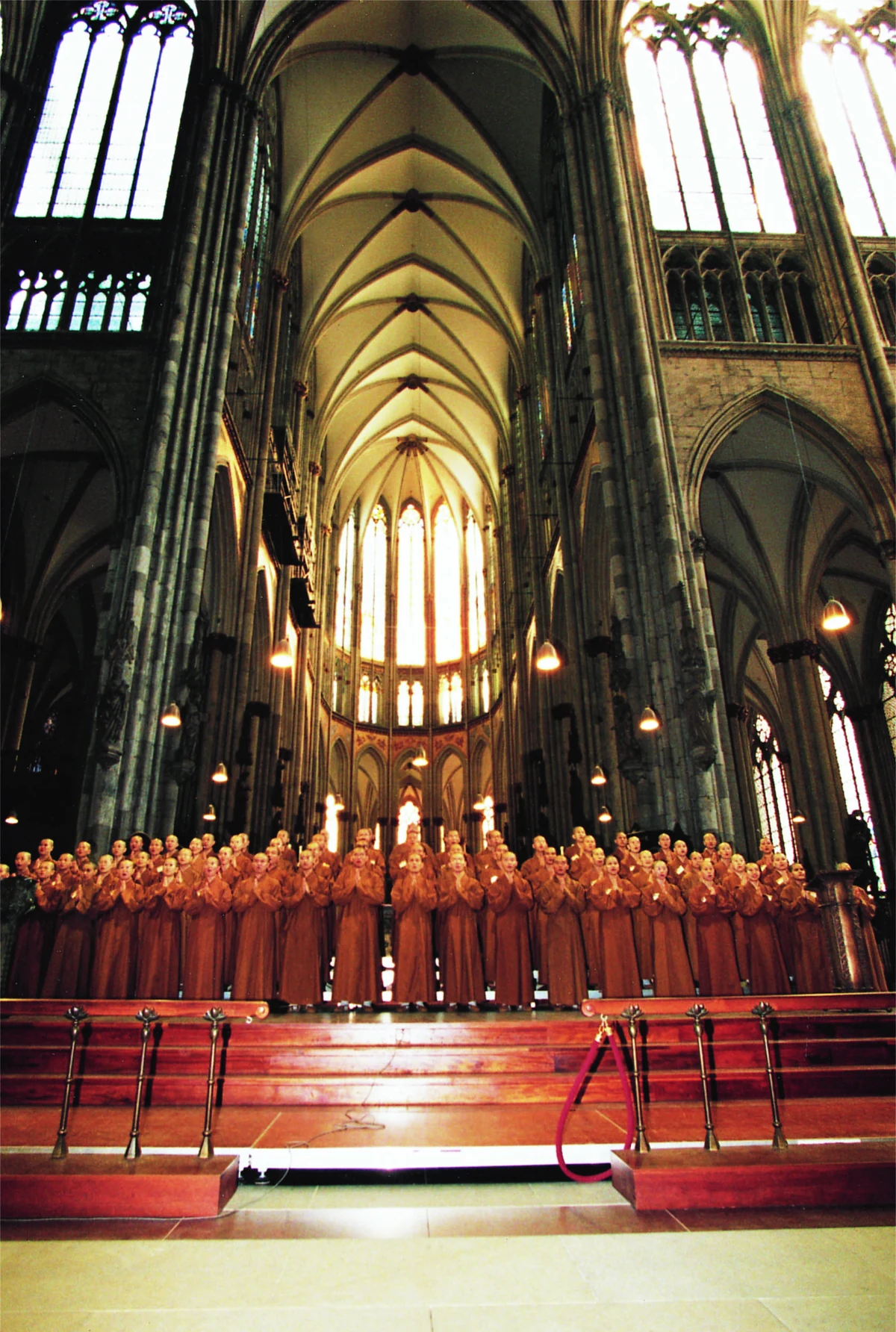
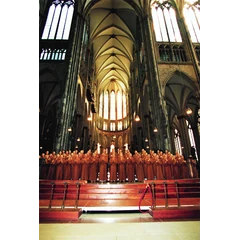
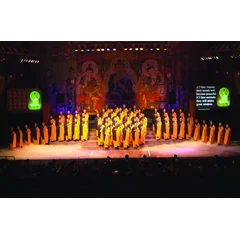
Leading "Fo Guang Shan Buddhist Hymn Choir" on Month-Long European Propagation Tour

On September 1, 1999, Venerable Master Hsing Yun led the "Fo Guang Shan Buddhist Hymn Choir" on a month-long European propagation tour. Starting September 3, they performed 11 shows successively at Austria's Vienna Kurhalle Oberlaa, London's Royal Opera House, London's Corn Street, Netherlands' Amsterdam, Germany's Rhine region, Belgium's Ghent, France's Paris, Switzerland's Lucerne and Basel, and Germany's Berlin.

Venerable Master stated that leading the "Fo Guang Shan Buddhist Hymn Choir" of 120 people on tour in ten European countries, witnessing thousands of Europeans and Americans' enthusiastic response and thunderous applause, he was moved beyond words, joining palms in prayer: May the world always be beautiful, and peace always remain among humanity.

September 21, 1999

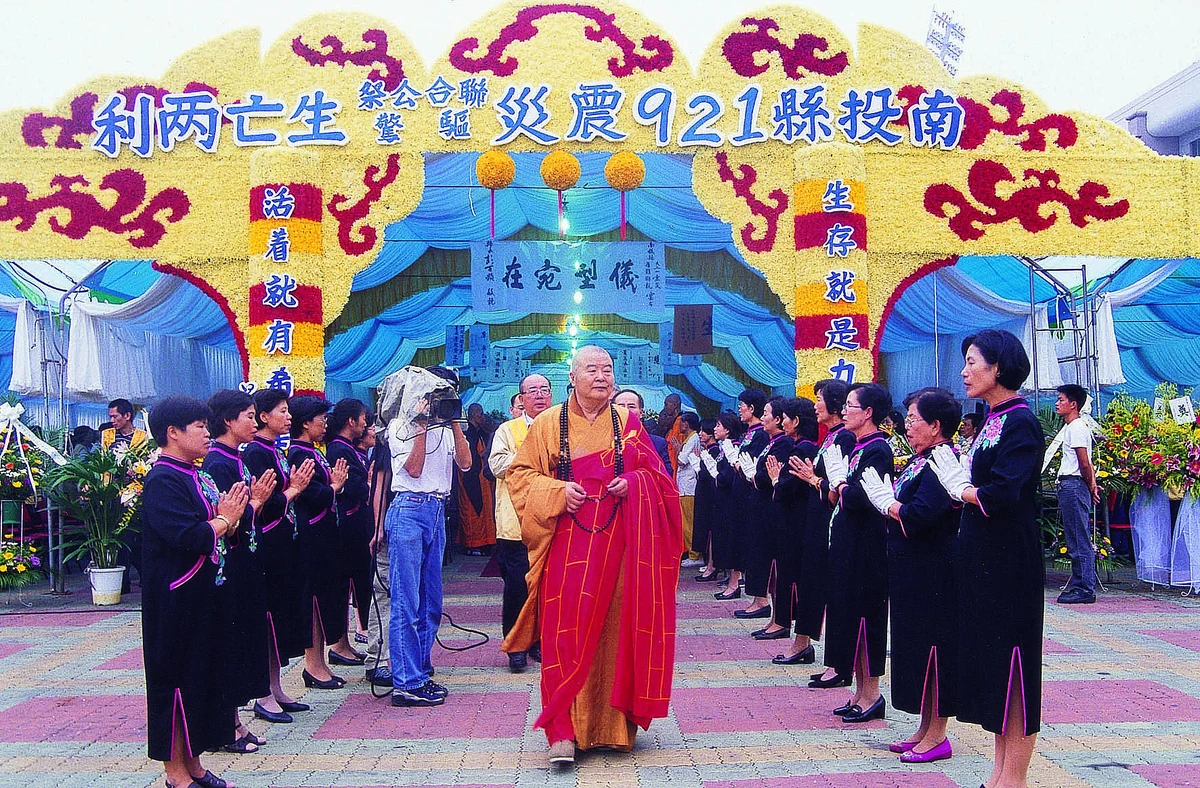
"921 Earthquake" Disaster Relief and Reconstruction

On September 21, 1999, Taiwan experienced a magnitude 7.3 earthquake that shook the entire island with severe casualties. Upon learning of Taiwan's disaster, he immediately directed establishment of "Fo Guang Shan and BLIA Joint Disaster Relief Centers" in Taiwan's northern, central, and southern regions, simultaneously mobilizing 500 monastics and 15,000 BLIA members to immediately proceed to medical facilities and disaster areas to assist and console victims, providing clothing, food, and other supplies, as well as conducting recitations for the deceased and assisting with funeral arrangements. Later, Fo Guang members worldwide and those with affinity contributed nearly NT$400 million, rebuilding nine elementary schools in Nantou and Taichung, constructing Fo Guang Village, providing nutritious lunches, and establishing multiple "Fo Guang Garden Compassion Stations" for mental health counseling. Venerable Master Hsing Yun taught that earthquakes can destroy the conditioned world of formation, abiding, decay, and emptiness, but cannot topple their faith in Dharma body and wisdom life. He further hoped this demonstration of the land's fragility would open people's hearts, so they would henceforth cherish conditions and blessings even more, distance themselves from greed, anger, and ignorance, and together create a happy and fulfilling Pure Land.

2000

Celebrating Buddhism's 2,000th Anniversary of Eastward Transmission and First National Buddha's Birthday Holiday Activities

Venerable Master Hsing Yun attended "Celebrating Buddhism's 2,000th Anniversary of Eastward Transmission and First National Buddha's Birthday Holiday" series activities, including float parades, Compassion and Loving-Kindness People's Three Acts of Goodness public marathon, and simultaneous grand Buddha Bathing ceremonies and fairs in northern, central, and southern regions, integrating Buddha's Birthday joy into public life.

From 2009, for seven consecutive years, the "Celebrating National Buddha's Birthday and Mother's Day Buddha Bathing Ceremony" was held at Ketagalan Boulevard in front of the Presidential Office. Venerable Master inscribed the theme "A thousand monastics and ten thousand people celebrate Buddha's Birthday; one heart and ten vows repay mother's kindness." Buddhism's harmonious atmosphere transformed Ketagalan Boulevard, usually used for protests and political disputes, from conflict to peace, writing an extraordinary historical page. Each year, the President, Vice President, distinguished guests from around the world, model mothers, and 100,000 citizens participated together in this unprecedented grand occasion.

April 1, 2000

Merit Times Founded

On April 1, 2000, The Merit Times was founded, becoming the first daily newspaper published by the Buddhist community. From its founding, Venerable Master Hsing Yun has contributed articles daily, encouraging with "Where there is The Merit Times, there are blessings throughout the human world," becoming a positive-value, clear-stream media transmitting truth, goodness, and beauty, cooperating with Chinese newspapers worldwide, distributed across five continents.

August 21, 2000

"Buddha's Light Scouts" Officially Established

In 1996, Venerable Master Hsing Yun initiated establishing "Buddha's Light Scouts" at Fo Guang Shan branch temples worldwide. On August 21, 2000, the "Buddha's Light Scouts" was officially established at Fo Guang Shan's Tathagata Building. On September 3, the flag-receiving and troop-forming ceremony for various Buddha's Light Scouts' troops was held at National Sun Yat-sen Memorial Hall.

This groundbreaking initiative has epoch-making significance in Buddhism, being Buddhism's first global scout organization, from Beaver Scouts to Rover Scouts at different levels. They frequently participate in public service projects such as caring for elderly living alone and assisting post-disaster reconstruction, fully demonstrating scouts' three virtues of wisdom, benevolence, and courage.

September 10, 2000

Publication of Venerable Master's Pearls of Wisdom: Prayers for Engaged Living

On September 10, 2000, Venerable Master Hsing Yun's Pearls of Wisdom: Prayers for Engaged Living was published, pioneering a new genre of Buddhist devotional literature, intended as a model for devotees' morning and evening liturgy.

Venerable Master stated that Pearls of Wisdom: Prayers for Engaged Living's purpose is to provide Buddhists from all walks of life with reference material for prayers before Buddha or morning and evening liturgy. He hoped these prayers could become daily practice for home cultivation, with everyone's good vow-power jointly accomplishing a Pure Land in the human world.

December 6, 2000

Receiving "Outstanding Buddhist Contribution Award"

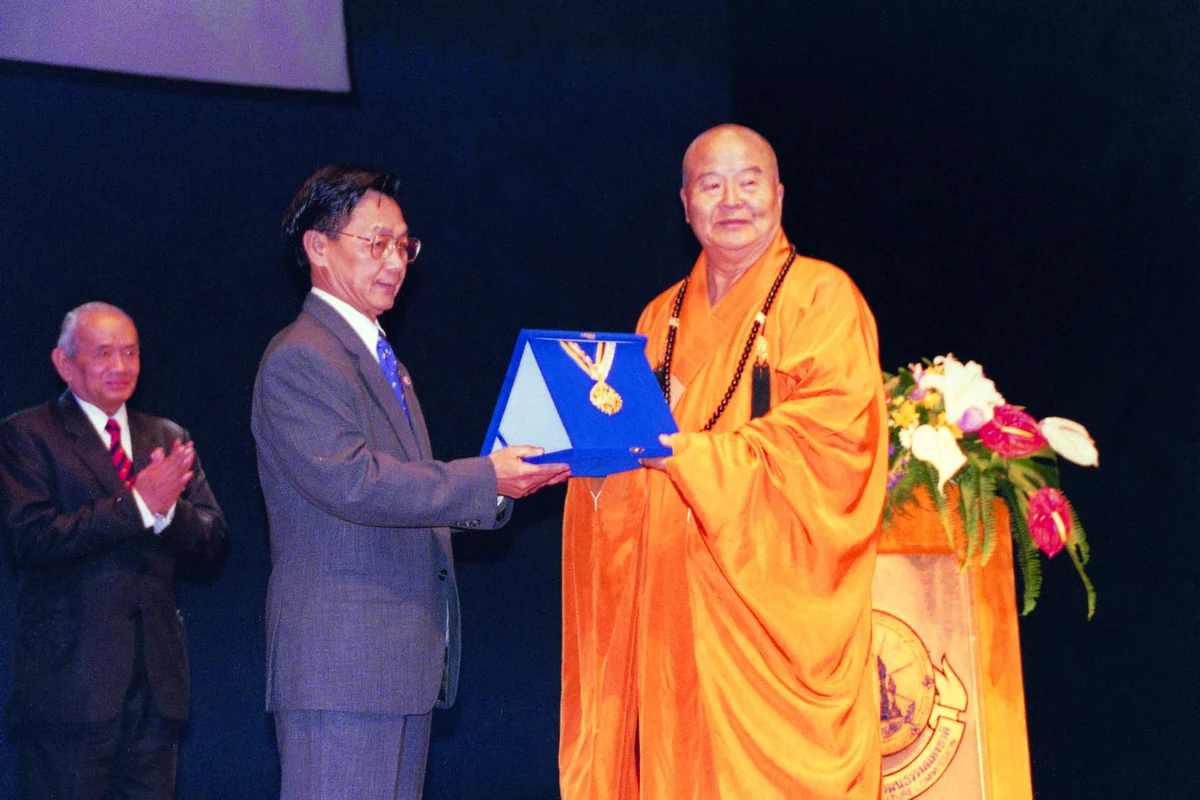
On December 15, 2000, at the 21st World Fellowship of Buddhists, Thai Prime Minister Chuan Leekpai personally presented the "Outstanding Buddhist Contribution Award," recognizing Venerable Master Hsing Yun's achievements in world Buddhism.

December 13, 2000

Venerable Master Donates Fo Guang Shan's Collection of Li Zijian's Painting "Nanjing 1937"

On December 13, 2000, Venerable Master Hsing Yun was invited to Nanjing's "Memorial Hall of the Victims in Nanjing Massacre by Japanese Invaders" to donate Fo Guang Shan's collection of Li Zijian's oil painting "Nanjing 1937," received by Nanjing Vice Mayor Xu Huiling.

Venerable Master stated in his remarks that in 1937, he was only ten years old, carrying two blankets on his shoulders, following the tide of tens of thousands of refugees fleeing. At that moment, the people dying, struggling in pain under guns and swords, was truly unimaginable. After some time, his mother, thinking of his father who had been doing business in the Nanjing area and had never returned home, took him to search for his father. In the vast sea of people, with war raging everywhere, he felt the Nanjing Massacre deeply.

Later in America, he met Mr. Li Zijian and, recognizing his talent, specially provided him a house to live in, letting him focus on creating meaningful paintings. When Li asked what to paint, seeing how lifelike his portraits were, Venerable Master said: "Paint a 'Nanjing Massacre,' but do not call it 'Nanjing Massacre. Name it 'Nanjing 1937,' everyone will understand at a glance."

January 1, 2001

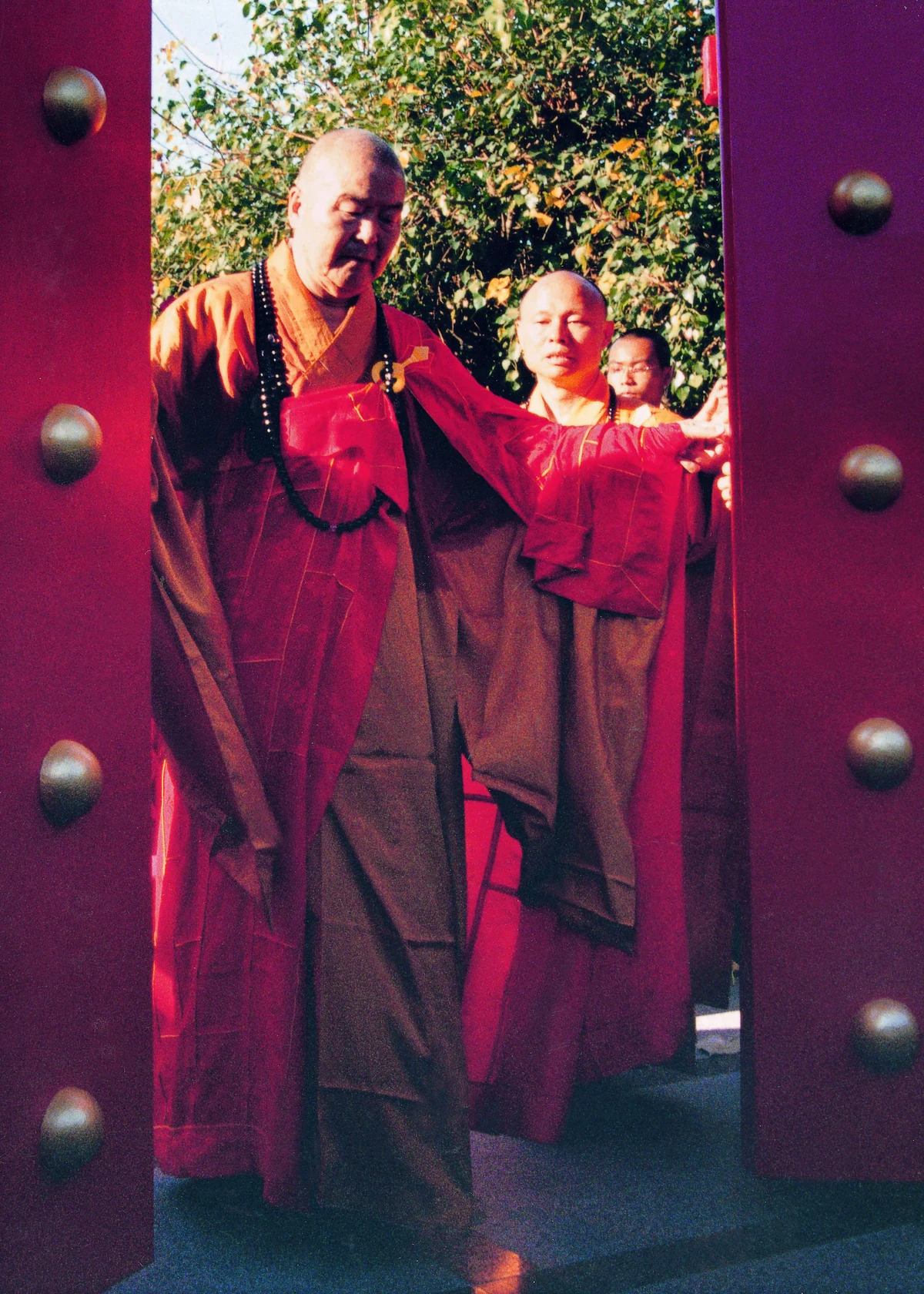
Fo Guang Shan Reopens Mountain Gates After over 3 Years of Sealing of the Mountain

After over three years of the Sealing of the Mountain, local leaders repeatedly requested reopening the mountain gates to prosper the region. President Chen Shui-bian, visiting Fo Guang Shan on December 25, 2000, personally requested Venerable Master Hsing Yun to let Buddha's light shine universally, benefiting all beings. Following the Religious Affairs Committee decision, the mountain gates reopened on New Year's Day the following year, with Abbot Venerable Hsin Ting presiding over the reopening ceremony. Tens of thousands of citizens once again went up the mountain to worship Buddha.

January 1, 2001

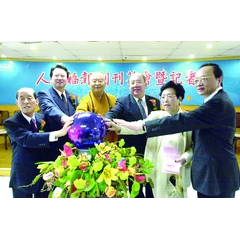
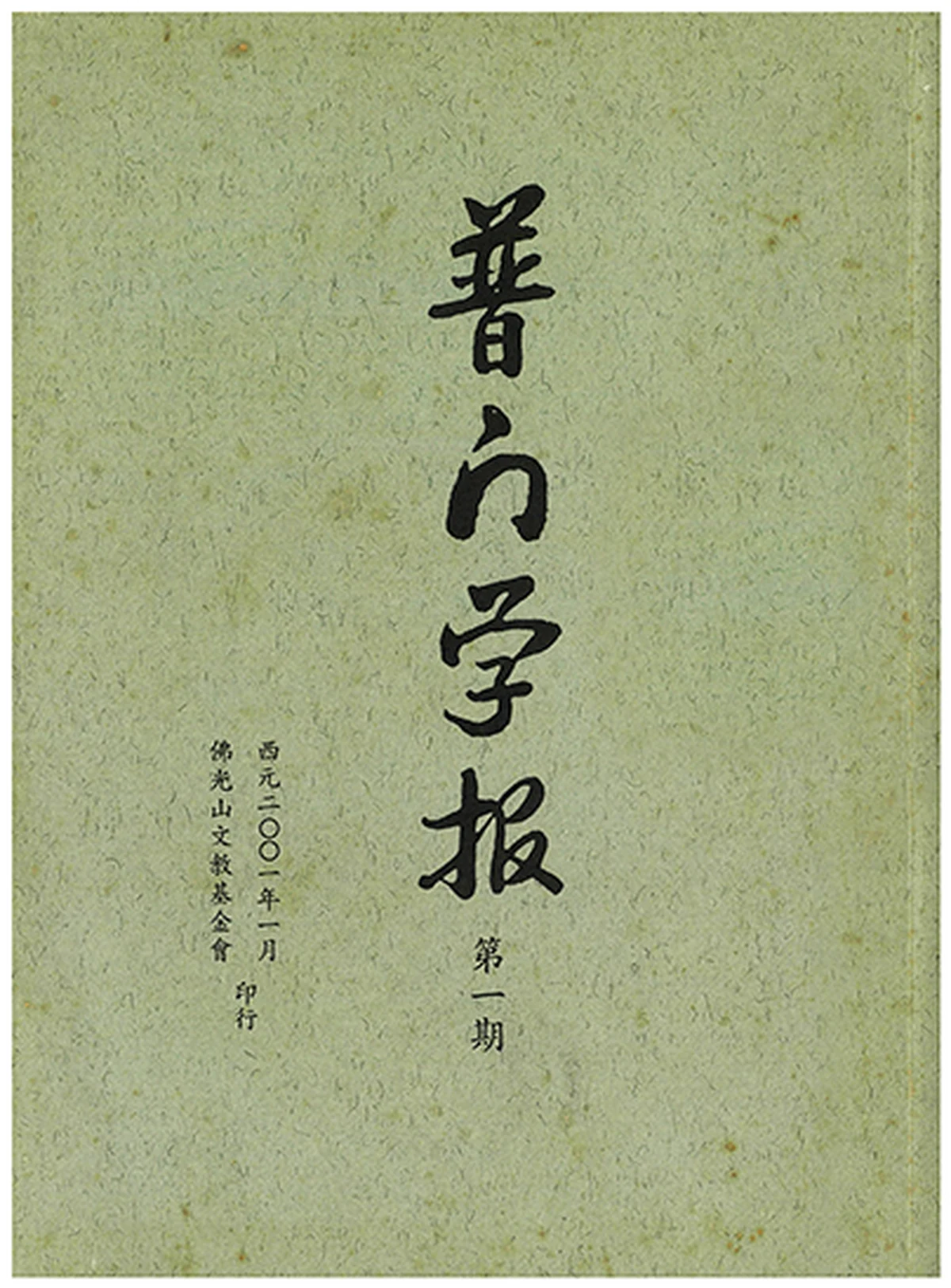
Universal Gate Magazine, Published for over 20 Years, Transforms into Universal Gate Buddhist Journal Bimonthly

Under Venerable Master Hsing Yun's guidance, Universal Gate Magazine, published for over 20 years, transformed into Universal Gate Buddhist Journal bimonthly. In 2016, it was renamed Humanistic Buddhism: Journal, Arts, and Culture, publishing academic papers and Buddhist artistic works.

October 2001

Leading Delegation to New York "9/11 Memorial Service" for the Victims

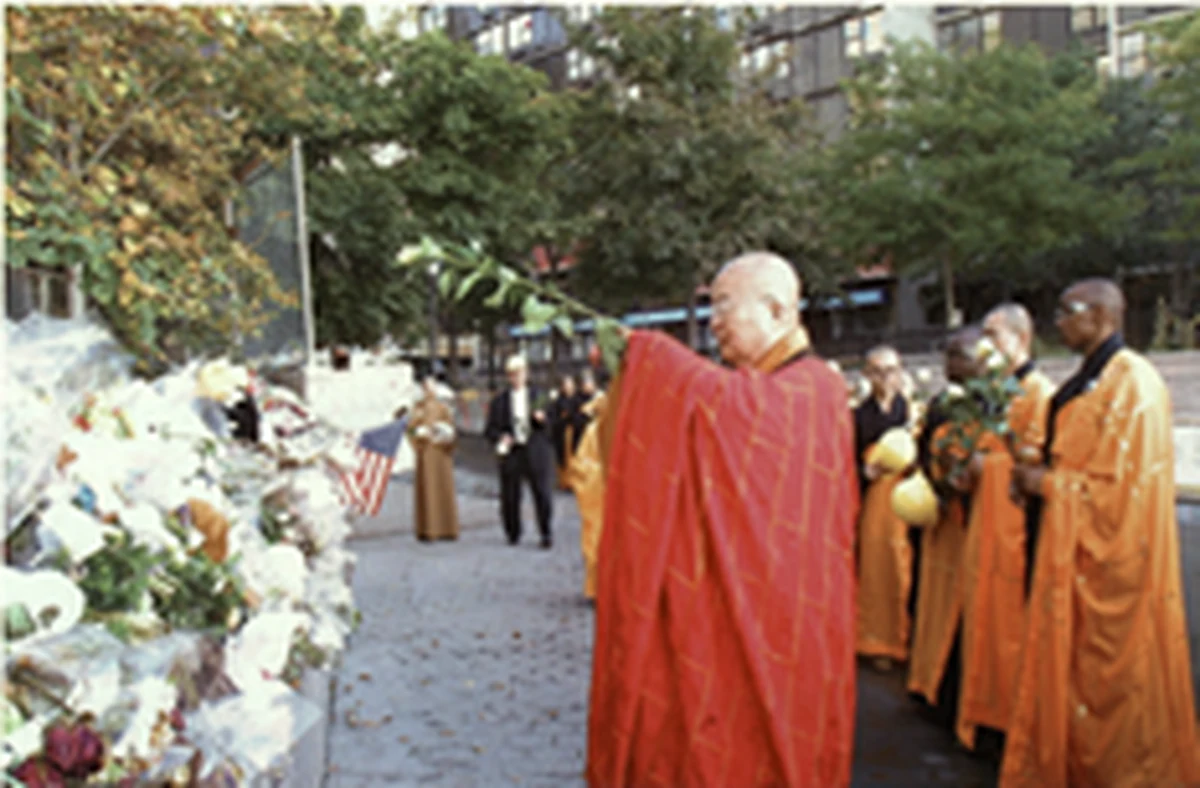
On October 19, 2001, Venerable Master Hsing Yun personally led 40 monastics to the World Trade Center disaster site to hold a "9/11 Memorial Service," specifically for memorializing 9/11 victims and blessing their families, hoping religion's compassion could dissolve worldly hatred, allowing races and religions to coexist peacefully.

Venerable Master, representing Fo Guang Shan, donated US$200,000 from the Fo Guang Shan Buddhist Hymn Choir's US-Canada tour proceeds to the American Red Cross for 9/11 relief funds.

October 19, 2001

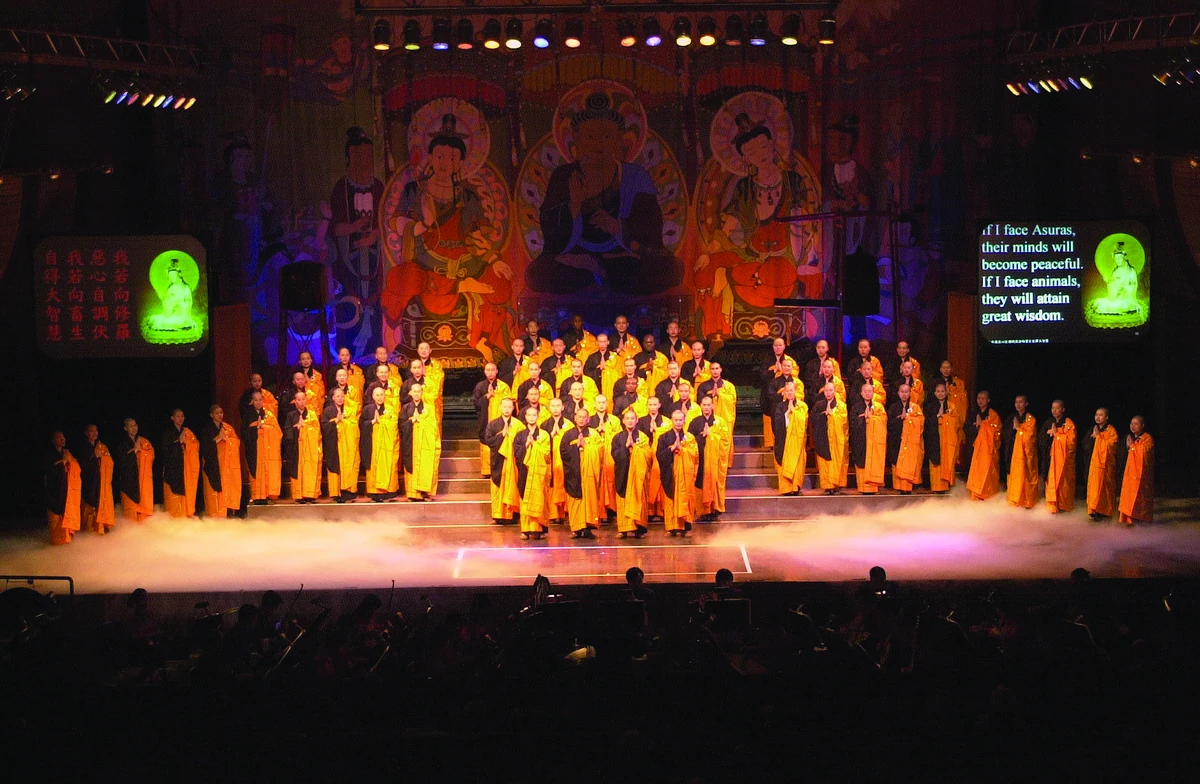
Fo Guang Shan Buddhist Hymn Choir Performs at New York's Lincoln Center

Sounds of the Ganges River–North American Buddhist Music Festival: The Fo Guang Shan Buddhist Hymn Choir performed at the world's premier New York Lincoln Center, a first for the Buddhist community.

January 2002

Establishing "Humanistic Buddhism Reading Association Headquarters" at Taichung Guangming Academy

In January 2002, the "Humanistic Buddhism Reading Association" founded by Venerable Master Hsing Yun was officially established, hoping to promote public reading culture and jointly create a book-fragrant society.

Venerable Master stated he had never attended any schools his entire life, yet loved buying and reading books. After reading, he always enjoyed sharing with others. When he first came to Taiwan in 1949, unable to afford three meals, he still didn't forget to open books to read. Reading increases knowledge, expands thinking, changes temperament, and elevates understanding. Books contain all kinds of wisdom; books contain all kinds of wealth.

February 2002

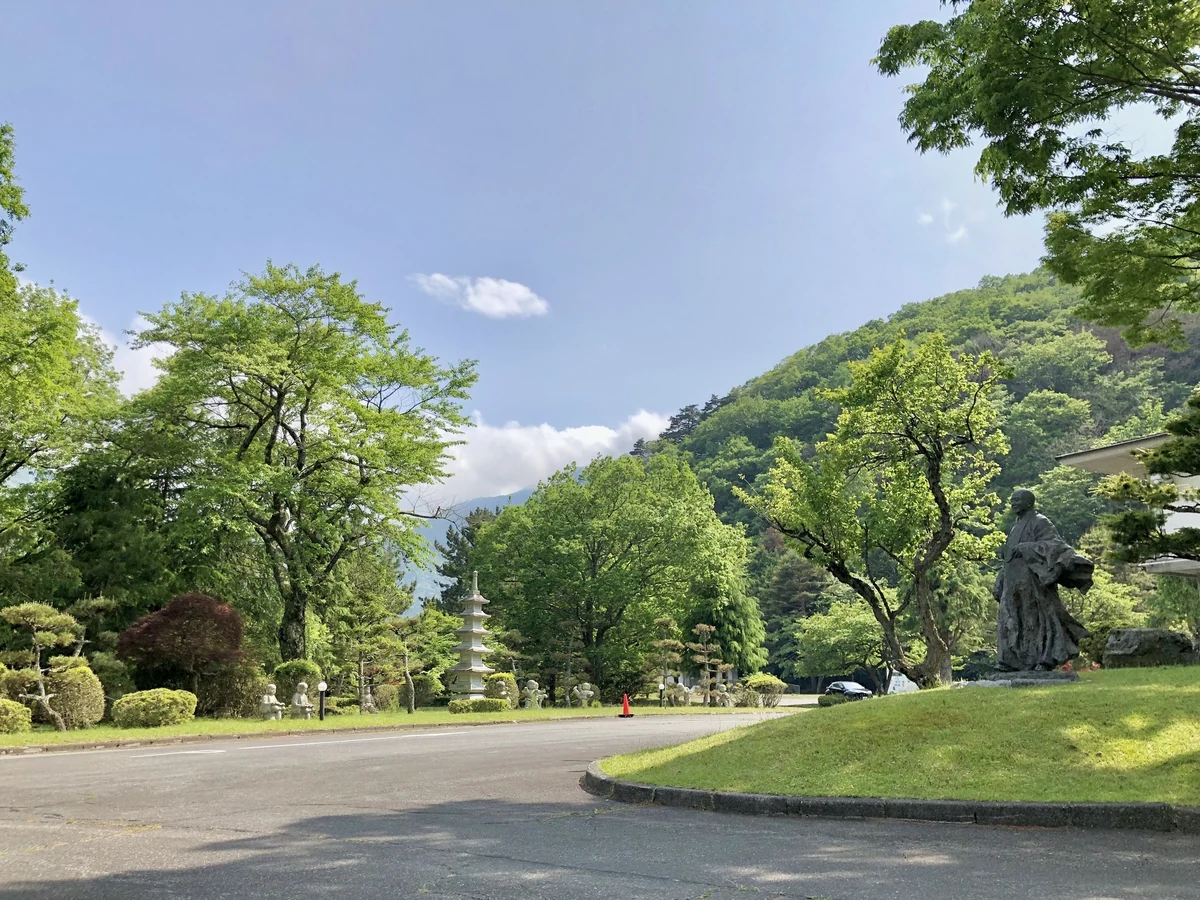
Fo Guang Shan Establishes Rinzai school "Motosu Temple" at Foot of Japan's Mount Fuji

Fo Guang Shan established the Rinzai school "Motosu Temple" at the foot of Japan's Mount Fuji as a venue for cultural activities and training monastics and laypeople.

Motosu Temple occupies 15,000 ping, with a main hall accommodating 1,000 worshippers, classrooms, meeting rooms, dining halls, and dormitories for 300 people. From any building, one can view Mount Fuji's majestic form and Lake Motosu's sparkling waters, beautiful lake and mountain scenery that cleanses dust and purifies thoughts.

Note:
"Motosu" is named because it is located beside Lake Motosu at the foot of Mount Fuji, and because Venerable Master Hsing Yun's lineage is from mainland China's Qixia Mountain, thus the name "Motosu" (Root-Dwelling Temple).

February 23, 2002

Famen Temple "Buddha's Finger Relic" Visits Taiwan

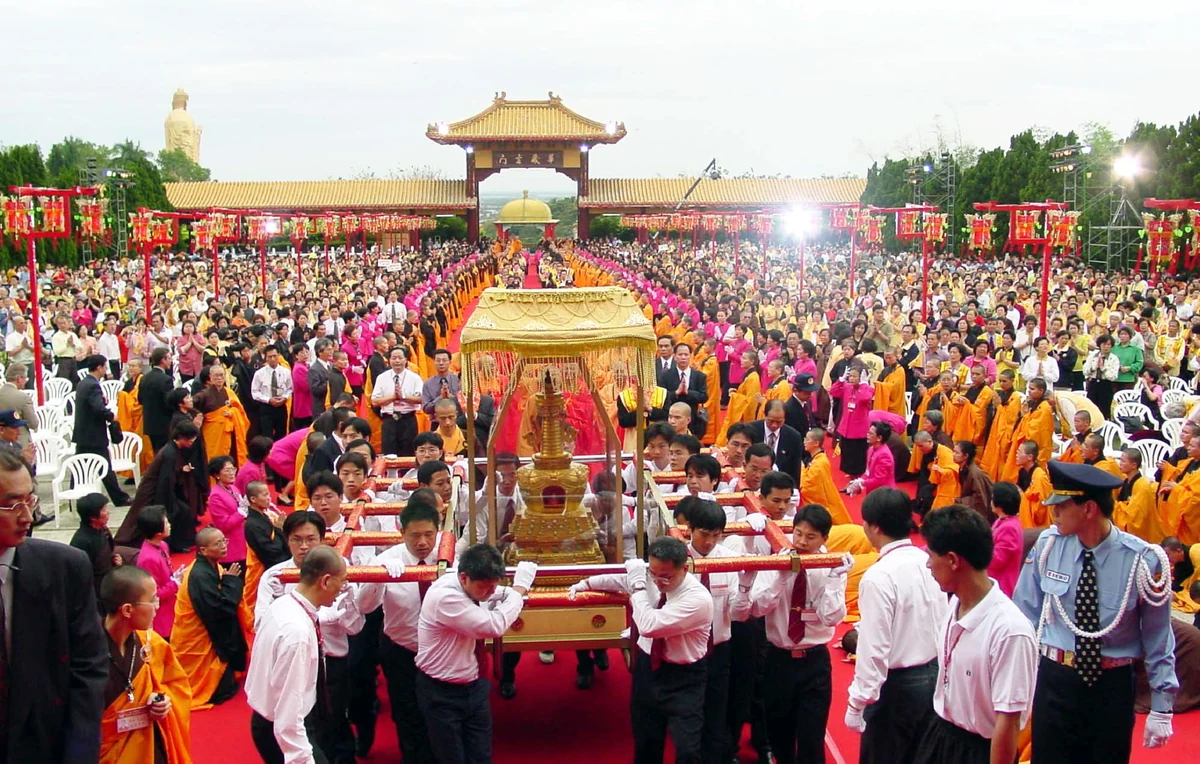
An agreement was reached with mainland China for the Buddha's Finger Relic to visit Taiwan, with the sixteen-character principle "Hsing Yun takes the lead, jointly welcoming, collectively venerating, absolutely secure." On February 23, 2002, Venerable Master Hsing Yun, Wu Po-hsiung, and over 400 monastics and laypeople went to Xi'an's Famen Temple to welcome the relic to Taiwan. Displayed for 37 days, 5 million people paid respects.

The first stop was enshrined at NTU Sports Center, followed by Jin Guang Ming Temple, Fo Guang Shan Monastery, Taichung Stadium, and Chung Tai Chan Monastery for public veneration.

This Buddha's finger visit to Taiwan promoted great unity and harmony in Taiwan's Buddhist community, also establishing a model of friendly exchange between people on both sides of the strait.

November 13, 2002

"Indochina Peninsula Charitable Journey"

Venerable Master Hsing Yun traveled to Laos, Cambodia, Myanmar, Vietnam, and other countries for a nine-day "Indochina Peninsula Charitable Journey." Besides providing charitable assistance to local people, it also built bridges of harmony and communication for Northern-Southern Buddhist exchange.

Venerable Master stated that arranged by Malaysia's Dato' Hiew Min Yong, he undertook this Indochina Peninsula charitable propagation journey, representing BLIA and Cao Zhong Zhi Foundation, donating 1,500 wheelchairs to charitable organizations in Laos, Cambodia, Myanmar, Vietnam, and Singapore.

2003

BLIA Passes UN Review and Officially Becomes "United Nations Non-Governmental Organization" (NGO) Member

Buddha's Light International Association passed the United Nations review and officially became a "United Nations Non-Governmental Organization" (NGO) member.

January 12, 2003

"Buddha Museum Groundbreaking Ceremony"

On January 12, 2003, Venerable Master Hsing Yun presided over the "Buddha Museum Groundbreaking Ceremony" at Qingtian Square beside Kaohsiung Fo Guang Shan. Over 50,000 people attended. Venerable Master stated: "In this era of global turmoil, people worldwide yearn for 'stability. Buddha Museum is not just material construction but spiritual construction; Fo Guang Shan has no money but has 'heart,' as much heart as we have, that much we can do. In the future, Buddha Museum will not only belong to Fo Guang Shan but to all people, shared by all sentient beings in the Dharma realm."

Venerable Master said, some people ask how much the Buddha Museum construction costs? We have no permanent assets nor surplus funds, only a single petal of "heart incense" to offer to the Buddha, hoping the Buddha will bless them with strength, enhance their wisdom, help us practice compassion, and build their faith.

The construction of Buddha Museum has the same significance as the government building high-speed rail or MRT; the difference is that building high-speed rail and MRT is "hardware construction," while Buddha Museum is "spiritual construction. Using this positive approach to build society and purify people's minds.

April 25, 2003

Specially Writing "Prayer for SARS Epidemic," Praying to Stabilize People's Minds

On April 25, 2003, Taiwan experienced a severe SARS epidemic. Venerable Master Hsing Yun, in Japan at the time, upon learning the news, specially wrote "Prayer for SARS Epidemic," praying to stabilize people's minds. Natural disasters and human calamities frequently occur throughout history's torrent; epidemics are often recorded in history's pages.

Now with the spread of SARS, if response and efforts are limited to certain individuals or certain administrative agencies, it will be too little too late. Only by awakening all people to self-reflection, everyone sharing in these difficult times, each person cultivating virtue and purifying their mind, improving social morals, and purifying the minds of all people, can they transform collective karma.

Only when everyone practices integrity, holds compassion in heart, creates blessings and cultivates goodness, and benefits sentient beings; when everyone reduces killing, reduces extravagance, reduces moral failures, reduces exploitation, all people following faith's conscience, maintaining repentant hearts, under the radiance of sun and moon, they hope heaven, earth, spirits, and all Buddhas and bodhisattvas bless them to once again have a world of clear skies and gentle breezes.

May Taiwan and other countries and regions where epidemics are spreading see the epidemic eliminated.

April 27, 2003

Venerable Master, at Taipei City Government's Request, Records Spiritual Message for Taipei City Hospital People Isolated Due to SARS Epidemic

On April 27, 2003, at Taipei City Government's request, Venerable Master Hsing Yun recorded at FGS Tokyo a spiritual message for Taipei City Hospital people isolated due to SARS epidemic, encouraging everyone to remain calm in danger, composed in crisis. Facing worldly difficulties and adversity, as long as one has a compassionate heart, a wise heart, a pure heart, and a heart of great vows, one can transform danger into safety. At this moment of social chaos, calmly recite Avalokitesvara Bodhisattva's sacred name. Temporary isolation, though restricting life and reducing freedom, why not step back and think of it as closed retreat, using this opportunity for reflection, quiet cultivation, and Buddha recitation, purifying body and mind, certainly transforming danger into safety.

Venerable Master took the lead in prayer, comforting panicked medical personnel, patients, families, and the general public. BLIA members engaged in service, taking shifts at public places to measure people's temperatures and promote correct protective measures; held memorial services and recitation ceremonies for medical personnel who died fighting the epidemic; and mobilized BLIA members worldwide to donate over 400,000 N95 surgical masks, over 100,000 isolation gowns, 3,000 thermometers, and other supplies.

July 2003

Attending "Cross-Strait and Hong Kong-Macau Buddhist Prayer Assembly" at Xiamen South Putuo Temple

On July 9, 2003, Venerable Master Hsing Yun was invited to Xiamen's South Putuo Temple to attend the "Cross-Strait and Hong Kong-Macau Buddhist Prayer Assembly for Subduing SARS, National Peace, and World Peace."

July 11, 2003

Venerable Master Invited to Unveil Plaque for "Buddhist Studies Research Center" at Xiamen University

On July 11, 2003, Venerable Master Hsing Yun was invited by Xiamen University to attend its Buddhist Studies Research Center plaque-unveiling ceremony. Over 200 monastics and laypeople from across the strait and four regions attended, including Buddhist Association of China President Venerable Yicheng, Hong Kong Buddhist Association President Venerable Kok Kwong, and Macau Buddhist Association President Venerable Kin Chiu. The unveiling ceremony was held at the university's Songsi Building and jointly presided over by Xiamen University Vice President Professor Deng Liping and Minnan Buddhist Academy President Venerable Shenghui.

Venerable Master accepted appointment as the center's honorary advisor, immediately writing "Dharma Realm as Mind" to congratulate the center's establishment, and donating the Fo Guang Buddhist Canon including one set each of the Āgama Canon, Chan Canon, Pure Land Canon, and Prajñā Canon, plus one set of the Collection of Contemporary Buddhist Works: Chinese Buddhist Academic Series. Venerable Master stated that the establishment of a university depends first and foremost on faculty and library resources, and he generously donated the Canon to enrich the center's library collection.

August 17, 2003

Venerable Master Attends First "Sounds of the Human World—Buddhist Song Presentation"

On August 17, 2003, Venerable Master Hsing Yun attended Fo Guang Shan Foundation for Buddhist Culture & Education's first "Sounds of the Human World—Buddhist Song Presentation," teaching over 300 young people from America, Argentina, Malaysia, Australia, Hong Kong, Brazil, Singapore, Philippines, Canada, Taiwan, and other places.

Venerable Master said that on the occasion of the 50th anniversary of propagating Dharma in Taiwan, he recalled the situation fifty years ago when he established the Buddhist Youth Choir in Yilan. Venerable Tzu Hui, who was one of the members at that time, initiated and organized the "Sounds of the Human World—Buddhist Song Presentation."

In just three months, over 1,000 composers from more than a dozen places including America, Canada, Argentina, Brazil, Australia, Hong Kong, Japan, Singapore, Philippines, Malaysia, and Taiwan submitted over 3,000 works in various languages including French, Portuguese, English, Japanese, Cantonese, Hakka, Taiwanese, and Mandarin.

Eighty selected songs were performed by groups brought from around the world to Taiwan, with ten performances at Taipei's Sun Yat-sen Memorial Hall, Kaohsiung Cultural Center, and Tainan Cultural Center, a grand occasion. Venerable Master's years of advocating music for propagation finally blossomed and bore fruit.

October 5, 2003

Brazil Sao Paulo "Zu Lai Temple" Completed After 11 Years of Construction

On October 5, 2003, Brazil São Paulo "Zu Lai Temple," after eleven years of construction, was completed. Venerable Master Hsing Yun presided over the dedication ceremony with São Paulo State Governor Dr. Geraldo Alckmin, São Paulo State Federal Police Chief Dr. Francisco Vicente Badenes, Cotia Mayor Dr. Quinzinho Pedroso, and others jointly cutting the ribbon, with nearly 10,000 attending. Brazilian President Luiz Inácio Lula da Silva personally signed congratulatory letters welcoming Venerable Master's visit to Brazil and congratulating Zu Lai Temple's completion.

At the ceremony, São Paulo State Governor presented a silver plaque stating "São Paulo State, through legislative assembly resolution, designates the second Sunday of May each year as Buddha's Birthday," thanking Venerable Master for bringing Buddhism's light to Brazil. Cotia City also presented a silver plaque expressing gratitude and respect for Venerable Master.

With Brazil's largest television station Rede Globo covering and broadcasting, over 60 million people nationwide watched the ceremony live. Over ten electronic and print media outlets including Band Rante, Simple Life Magazine, Esforce Magazine, and Jornal Alpha Magazine also sent reporters for full coverage and recording. It can be said that it caused a tremendous sensation throughout Brazil.

November 2, 2003

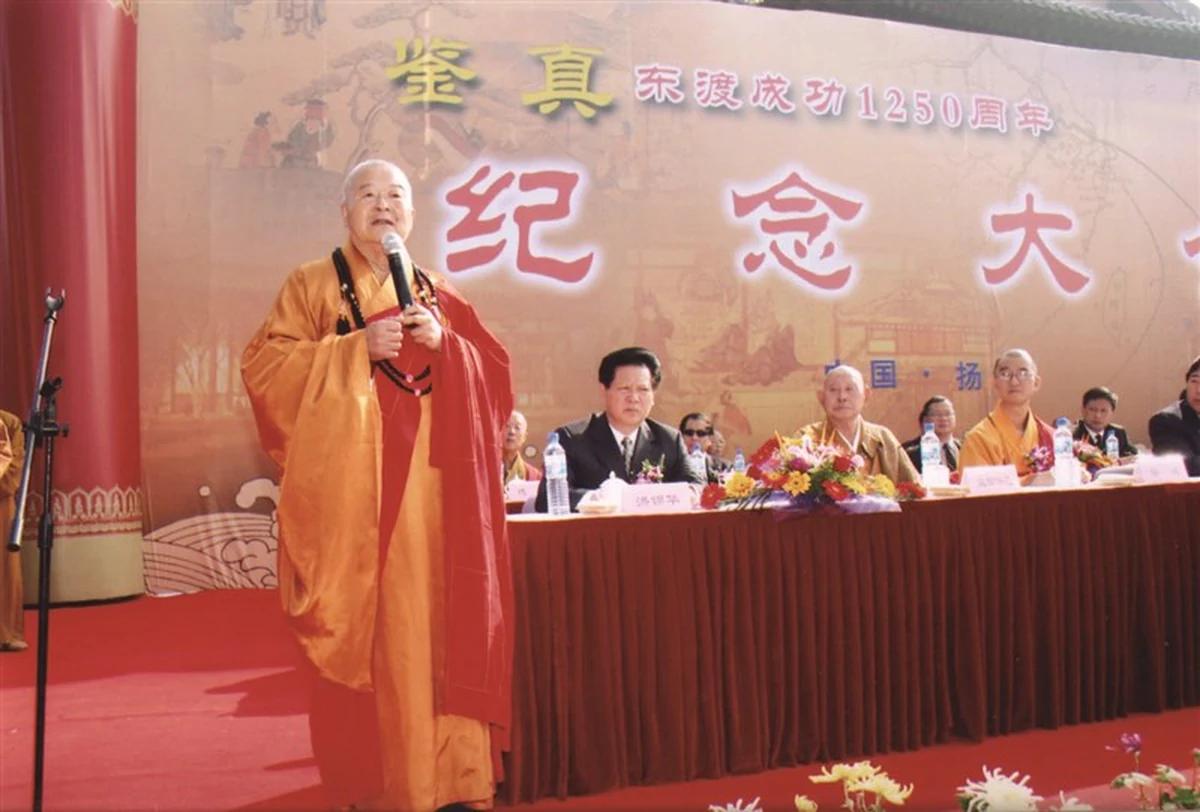
Attending "Master Jianzhen's Successful Eastern Voyage 1250th Anniversary Memorial Assembly" at Yangzhou Daming Temple

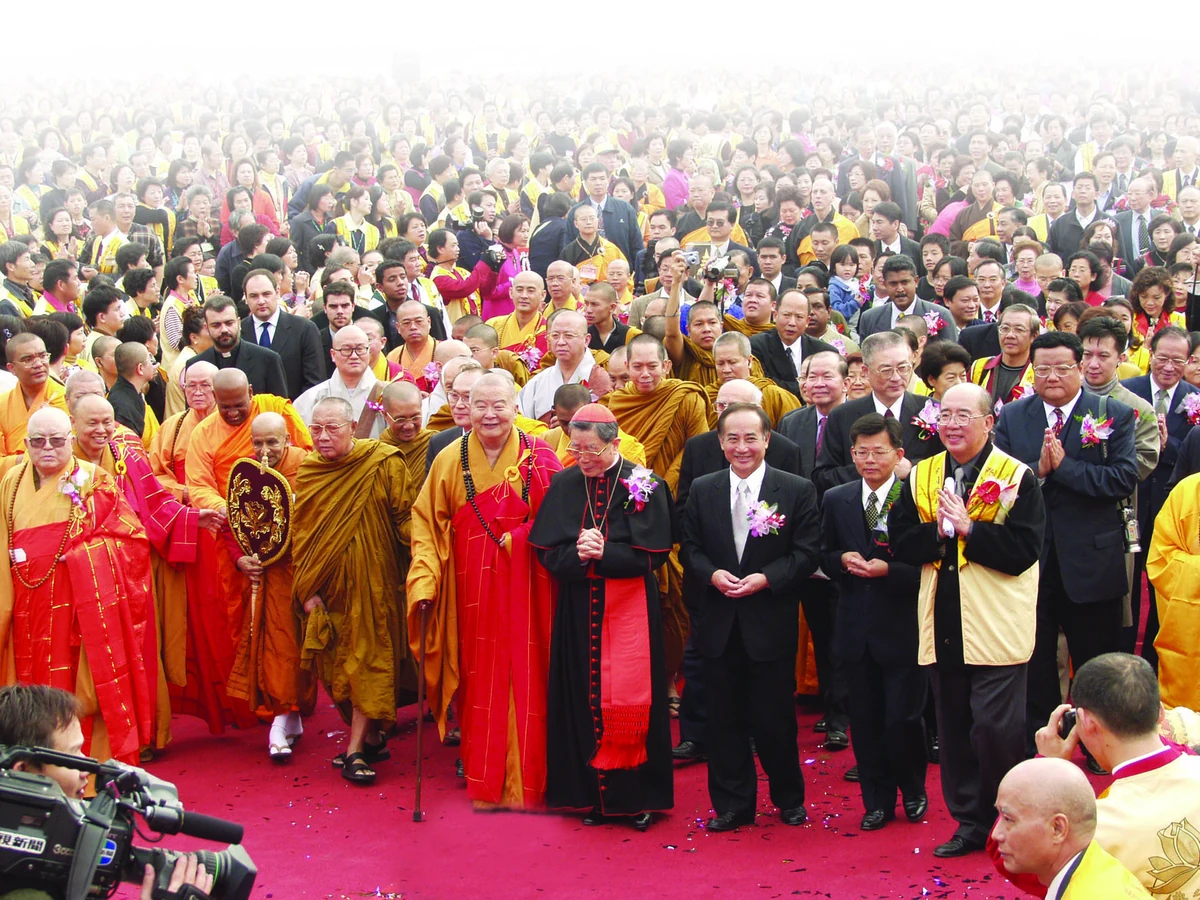
On November 2, 2003, Venerable Master Hsing Yun was invited to return to his hometown Yangzhou to attend the memorial assembly commemorating Tang dynasty eminent monk Master Jianzhen's 1250th anniversary of successful voyage to Japan for Dharma propagation, jointly organized by Chinese and Japanese Buddhist communities at Yangzhou Daming Temple. Over 5,000 attendees included monastics and laypeople from across the strait and three regions, Japanese Buddhist community members, as well as central and local government leaders. Venerable Master, like Jianzhen, is from Yangzhou, making him the only invitee from Taiwan's Buddhist community.

Venerable Master stated in his remarks that Chinese Buddhist history has two patriotic monks: one is Xuanzang, who traveled west seeking Dharma, and the other is Jianzhen. For transmitting vinaya to Japan, Jianzhen underwent six voyages over twelve years of hardship, only reaching Japan at age 66 when already blind. It was due to this great religious sentiment of "for the Buddha-Dharma, why begrudge one's life" that Japanese Buddhism flourishes today. Besides commemorating Master Jianzhen's historical legacy and contributions to posterity, hearing that Daming Temple will establish the Jianzhen Academy to cultivate international Buddhist talent is deeply meaningful.

November 20, 2003

"Fo Guang Shan Buddhist Hymn Choir" Goes to Mainland China for Performances

On November 20, 2003, the "Fo Guang Shan Buddhist Hymn Choir," at invitation from Chinese National Academy of Arts' Religious Art Research Center, participated in "Chinese Buddhist and Taoist Music Essence Exhibition" performances in Beijing and Shanghai, the first record of Taiwan Buddhist group music art performing on the mainland. Venerable Master Hsing Yun gave remarks after the performance at Shanghai Grand Theatre. Over 1,000 people attended including State Administration for Religious Affairs Director Ye Xiaowen, Deputy Director Qi Xiaofei, and guests from home and abroad.

The ensemble's first invitation to mainland China for performances created the precedent for Taiwan Buddhist groups officially conducting music and art exchange with the mainland, opening a new page in promoting cross-strait religious and cultural exchange.

January 15, 2004

Celebrating Thai Supreme Patriarch's 90th Birthday, "Welcoming Golden Buddha Enshrinement Ceremony"

On January 15, 2004, the "Welcoming Golden Buddha Enshrinement Ceremony" was held at Buddha Museum's designated site at Fo Guang Shan. Deputy Supreme Patriarch Somdej Phra Yanvarodom, Venerable Master Hsing Yun, Fo Guang Shan Abbot Venerable Hsin Ting, over twenty Thai monastic and lay representatives, and over ten thousand devotees welcomed the Buddha, symbolizing Northern-Southern Buddhist harmony and international friendship exchange.

Appreciating Fo Guang Shan's dedication to promoting Humanistic Buddhism and its many contributions to education, culture, and charity, and to express the Thai Buddhist community's reverence for Fo Guang Shan and Thai people's spirit of offering, the Supreme Patriarch designated Fo Guang Shan as the sacred site in Taiwan to enshrine the great golden Buddha. This great golden Buddha stands four meters tall and weighs two metric tons.

Personally supervised by Thai Princess Maha Chakri Sirindhorn, it was escorted to Taiwan for enshrinement by the Deputy Supreme Patriarch and a delegation of over forty people, representing Northern-Southern Buddhist harmony and affirming Fo Guang Shan's international promotion of Humanistic Buddhism concepts and contributions.

February 20, 2004

"Chinese Buddhist Music Exhibition Ensemble" Tour Performances

The Fo Guang Shan Buddhist Hymn Choir and Buddhist Association of China's Chinese, Tibetan, and Theravāda Buddhist traditions from the three major language systems and five great monasteries formed the "Chinese Buddhist Music Exhibition Ensemble" with over 100 monastics from both sides of the strait. Members included Taiwan's Fo Guang Shan Monastery, Fujian's Xiamen Nanputuo Temple, Guangdong's Ruyuan Yunmen Temple, Shantou Anshou Temple, Henan's Songshan Shaolin Temple, Gansu's Xiahe Labrang Monastery, Beijing's Yonghe Temple, and Yunnan's Wat Pajie Maharajatan Sipsong Panna, a grand lineup. Venerable Master Hsing Yun served as honorary director, touring Macau, Hong Kong, US, Canada, and Taiwan, writing a new chapter in cross-strait Buddhist exchange.

May 23, 2004

Venerable Master Receives Honorary Doctorate from Thailand's Mahamakut Buddhist University

On May 23, 2004, Venerable Master Hsing Yun received an Honorary Doctorate in Religious Buddhist Studies from Thailand's Mahamakut Buddhist University of the Dhammayuttika Nikāya, setting the record as the first Northern Buddhist (Mahāyāna) master to receive recognition from both of Thailand's two major traditional Buddhist orders: Chulalongkorn and Mahamakut.

Venerable Hsin Ting attended to receive the degree on his behalf.

Venerable Master stated that these honors are the collective achievement of everyone, and represent recognition from all quarters for the work of Buddhist Dharma propagation. This recognition strengthens the sense of mission for world peace and human welfare. Only by "offering this body and mind to serve all lands" can one live up to the support of the ten directions and the achievements of the community.

September 25, 2004

Jiun Tou Elementary & Junior High School Founding Ceremony

On September 25, 2004, Nantou County's first Buddhist-founded Jiun Tou Elementary & Junior High School held its founding ceremony. Venerable Master Hsing Yun personally cut the ribbon, with over 5,000 Fo Guang members gathered in celebration.

Venerable Master stated that founding Jiun Tou Elementary & Junior High School hopes Buddhism can contribute to Taiwan's education. Juntou was the most famous young novice in Buddha's time; under Buddha's and Venerable Śāriputra's compassionate care, he attained arhatship at age seven. The school is named after him, with the aspiration that all students may "jiun" 均 (equally/all) rise to become outstanding "tou" 頭 (heads/leaders), everyone becoming pillars of society.

November 2004

Transmitting International Triple Platform Full Ordination at Australia's Nan Tien Temple

Australia's Nan Tien Temple transmitted the International Triple Platform Full Ordination, with Venerable Master Hsing Yun as Preceptor, the first such event in Australian Buddhist history, also promoting Australia's multicultural development.

November 9, 2004

Venerable Master Invited by Austria's "Global Energy Prize" Organizers to Present "Earth" Award

On November 9, 2004, Austria, the initiating country for the Global Energy Prize, invited Venerable Master Hsing Yun to present the "Earth" award. Venerable Master also delivered a speech on "Humanity and Earth: Interconnected Coexistence," presenting Buddhism's view of earth's life and Buddhist environmentalism.

Speaking on "Humanity and Earth: Interconnected Coexistence," broadcast by Austrian National Television, Venerable Master called on Austrians and humanity worldwide to jointly treasure earth's resources. He stated that earth's life is like savings in a bank, when the savings are used up, one becomes poor. Likewise, if humanity does not treasure earth's energy, one day the earth will strike back.

Earth's life is in humanity's hands; it requires every person on earth to jointly focus on environmental protection and energy conservation. He also hoped to awaken global citizens' awareness of the energy crisis and mobilize all humanity to jointly care for the earth.

January 2, 2005

"Love and Peace Music Prayer Assembly"

The "Love and Peace Music Prayer Assembly," hosted by the Chinese Culture Renaissance Movement General Association's Religious Committee and organized by BLIA ROC, was held on January 2, 2005, at Taipei's Sun Yat-sen Memorial Hall. Under the call of Chairman Venerable Master Hsing Yun, Vice Chairman Cardinal Paul Shan Kuo-hsi, and other religious leaders, eleven religious groups including Buddhism, Catholicism, Taoism, and Islam responded, singing songs of "love" and "peace" to pray for world nations and bless South Asian disaster victims, praying for disasters to subside and happiness to descend. The warm atmosphere moved the entire audience to tears.

The evening assembly was led by Venerable Master together with Catholic Cardinal Paul Shan Kuo-hsi, he-Kuan Tao Association Vice Chairman Chien Hsin-fa, Tenrikyo Mission Headquarters in Taiwan Chief Hashimoto Takenor, The Lord of Universe Church Chairman Tung Ming-sheng, Tian De Association Chairman Hu Fu-lin, Presbyterian Church In Taiwan Assistant General Secretary Susan Chuang, Xuanyuan Association Vice Patriarch Lin Yu-pei, Taoist Association Secretary-General Chang Sheng, Chinese United Church of Liism Chairman Lin Sung-hui, and Chinese Muslim Association Chairman Hj. Through religious great love, conflicts and unease are resolved, making Taiwan a Pure Land of love.

January 16, 2005

Fo Guang Shan 7th Abbot Enthronement Ceremony

On January 16, 2005, Fo Guang Shan's 7th Abbot enthronement ceremony was held at Fo Guang Shan's Main Shrine. Venerable Master Hsing Yun read Fo Guang Shan's Dharma transmission document "Treasury of the True Dharma Eye," recounting Fo Guang Shan's lineage from Buddha to the Western First Patriarch Mahākāśyapa, transmitted to the Eastern Land First Patriarch Bodhidharma, then to Venerable Master Hsing Yun, Venerable Hsin Ping, Venerable Hsin Ting, and now transmitted to Venerable Hsin Pei, the 49th generation of Linji lineage and Fo Guang Shan's 7th Abbot. After the new Abbot's oath, all Religious Affairs Committee members pledged their support. As the Dharma scroll's mind-seal verse states: "Qixia transmits the branch lamp, illuminating the world from Taiwan; Buddha's light and Dharma water naturally flow forever," truly enabling generational succession.

Kaohsiung County Magistrate Yang Chiu-Hsing, Catholic Cardinal Paul Shan Kuo-hsi, I-Kuan Tao Association Chairman Xiao Hsiao Chia-chen, Korean Tongdosa Abbot Venerable Hyeonmun, Thai Dhammakaya Temple Abbot Phra Bhavanaviriyakhun, and Japan's Koyasan University President Chisho Namai came to offer blessings. The ceremony was witnessed by 5,000 distinguished guests from various countries and devotee representatives, adding to the honor.

February 17, 2005

The Chinese University of Hong Kong Establishes "Centre for the Study of Humanistic Buddhism"

On February 17, 2005, The Chinese University of Hong Kong and Fo Guang Shan Culture and Education Foundation cooperated to establish the "Centre for the Study of Humanistic Buddhism. The signing ceremony was held at Fo Guang Shan's Tathāgata Hall, with Venerable Master Hsing Yun and CUHK Faculty of Arts Dean Daniel Law signing the cooperation agreement on behalf of their respective organizations.

Venerable Master stated that since Fo Guang Shan's founding, it has always hoped to contribute to education and culture. The establishment of this "Centre for the Study of Humanistic Buddhism" makes Humanistic Buddhism and Chinese Buddhism research an important subject, with great influence for the future, the monastery is merely doing its humble part. Although today's signing is just a small step, for world Buddhism and cultural research, it is nonetheless a giant leap. Humanistic Buddhism is what Buddha taught humans, centered on humans, emphasizing elevating human spirituality, including modernization, internationalization, and integration with tradition. Religion has no national boundaries; even modern liberal democratic political systems and egalitarian thought should all be promoted. CUHK establishing the "Centre for the Study of Humanistic Buddhism" is an important development for Fo Guang Shan's promotion of "Humanistic Buddhism."

April 8, 2005

"To Enlighten Sentient Beings—An Exhibition of Calligraphy by Venerable Master Hsing Yun" Premieres at Malaysias National Art Gallery

On April 8, 2005, "To Enlighten Sentient Beings—An Exhibition of Calligraphy by Venerable Master Hsing Yun," planned by Fo Guang Shan Fo Guang Yuan Art Gallery Headquarters and co-organized by Fo Guang Shan Malaysia, premiered at Malaysia's National Art Gallery. Venerable Master was invited to preside over the opening.

Venerable Master wrote: "My disciple Venerable Ru Chang secretly organized the 'To Enlighten Sentient Beings' calligraphy exhibition at Malaysia's National Art Gallery without telling him. I was truly startled at the time, how could my calligraphy be exhibited at Malaysia's National Art Gallery? Wouldn't this be embarrassing to myself? However, thinking of my disciples' sincere efforts, I couldn't refuse to support them, so I happily went. That's why I often tell people: you cannot look at my calligraphy, but you can look at my heart, because I still have a little compassionate heart for you to see."

The exhibition subsequently toured UC Berkeley and University of the West in the United States; Hunan Provincial Museum, Chongqing Three Gorges Museum, Nanjing Museum, and Yangzhou Museum in China; Hong Kong Central Library and University of Hong Kong; as well as Australia, New Zealand, and other countries.

May 4, 2005

US Library of Congress Officially Establishes Separate Classification Number for "Fo Guang Shan" and "Venerable Master Hsing Yun" Publications

On May 4, 2005, the US Library of Congress officially established a separate classification number BQ9800.F63 in the Buddhism category of the Library of Congress Classification Schedule for over 50 translated works published by "Fo Guang Shan" and "Venerable Master Hsing Yun." "Humanistic Buddhism" and "Fo Guang Shan Buddhist Order" were also officially entered into the Library of Congress Subject Headings.

This was simultaneously published in the Library of Congress's Library of Congress Classification Weekly (2005, Issue 18), becoming an official American library classification number and entering the cataloging systems of universities, colleges, and libraries of all types.

July 15, 2005

Aurora Foundation Chairman Chen Yung-Tai Donates 125 Buddhist Artifacts to Buddha Museum

On July 15, 2005, Aurora Group Chairman Chen Yung-tai and wife donated 125 sets of underground palace artifacts collected over decades from around the world to Fo Guang Shan. Venerable Master Hsing Yun accepted on behalf, with former National Palace Museum Director Chin Hsiao-yi and the public as witnesses.

Mrs. Chen stated that these Buddhist sacred objects were originally created by ancient Buddhists out of devout faith to make offerings to Buddha bone relics. Now, due to natural or human factors, they have been scattered elsewhere. Although they cannot be returned to their original time and space, if they can be donated to a Buddhist organization for collection, they can better fulfill the spirit of Buddhism.

Later, the Chens chose Fo Guang Shan's Buddha Museum as the destination for these cultural treasures. On November 22, 2011, they donated an additional twenty replicated artifacts from Xi'an Famen Temple's underground palace. Combined with the previous donations, the total reached 145 pieces, including over twenty pieces donated by Aurora Museum Director Wu Tarng-hae and his wife, all displayed together at Buddha Museum's "Museum of Buddhist Underground Palaces" for public viewing.

September 2005

Common Health Magazine Recommends Venerable Master's Humanistic Buddhism: A Blueprint for Life

In September 2005, Common Health magazine's book reviewers Frederic and Mary Ann Brussat, following their previous reviews of Keys to Living Well and Tending Life's Garden: Between Ignorance and Enlightenment VI, recommended Venerable Master Hsing Yun's Humanistic Buddhism: A Blueprint for Life for the third time in their column for book lovers.

The article introduced Venerable Master as the founder of Fo Guang Shan and Buddha's Light International Association, propagating Humanistic Buddhism for over half a century. The goal is to enable the public, through culture, education, charity, and collective practice, to skillfully apply Buddha's compassion and wisdom in walking, standing, sitting, and lying down, making cultivation practical in daily life.

Both reviewers mentioned that Venerable Master always returns to morality, doing good, and cultivating virtues. For example: "Buddhism does not completely reject love, but Buddhism advocates 'transforming emotion with wisdom,' 'expressing emotion through compassion,' 'guiding emotion with Dharma,' and 'directing emotion with virtue.' Other topics such as explaining the true meaning of money and praising spiritual wealth all help everyone understand that through faith, morality, compassion, and wisdom, they can open up infinite life."

October 2005

Ancestral Temple Dajue Temple Groundbreaking Ceremony

On October 14, 2005, Fo Guang ancestral temple Dajue Temple groundbreaking ceremony was held.

Dajue Temple, located in Yixing City, Jiangsu Province, is a Chan temple of the Linji school. Built during the Southern Song Xianchun period (1265–1274), it has over 700 years of history. In 1989, Venerable Master Hsing Yun returned to Yixing to pay respects to ancestors and, seeing not a tile remaining of the temple, resolved to revive the ancestral temple.

In 2005, conditions matured for groundbreaking and revival. The current site features classical architectural style, located on the east side of Yun Lake, at Wangfeiling Gap, nestled against mountains and alongside water, with beautiful surroundings forming a distinctive regional landscape. Combining traditional Buddhist culture with modern propagation methods, it spreads Humanistic Buddhism.

November 8-9, 2005

Dialogue with Nobel Literature Prize Judge Professor Malmqvist and Swedish Sinologist Professor Loden

On November 8, 2005, Venerable Master Hsing Yun attended "Dialogue between Venerable Master Hsing Yun and Sinologists" at Taipei Vihara, dialoguing with Professor Göran Malmqvist on "Buddhism and Chinese Literature," with over 1,000 people listening. The two exchanged views on topics ranging from Buddhist poetry and classics in literature to historical figures, with incisive perspectives that kept the audience rapt with attention, frequently drawing laughter throughout the hall.

On the evening of the 9th, Venerable Master dialogued with Professor Torbjörn Lodén, member of the Royal Swedish Academy of Letters, History and Antiquities, on "Buddhism and World Peace. Topics included matters of public concern such as war and peace, Taiwan Strait security, and cross-strait relations. The two scholars from East and West both agreed that "compassion" is the path to world peace.

On the evening of the 10th, the third session "When East Meets West" symposium was held at Fo Guang Shan's Tathāgata Building Auditorium, with Venerable Master, Professor Malmqvist, and Professor Lodén together in discussion on the topic "Humanistic Buddhism. Over 2,000 people attended including Fo Guang Shan's fourfold assembly of monastics and laity, Pu-Men Senior High School teachers and students, and devotees.

2006

Fo Guang University Receives Ministry of Education Approval to Establish Buddhist Studies College

Fo Guang University received Ministry of Education approval to establish Buddhist Studies College, the first example of a comprehensive university establishing a Buddhist Studies college, formally bringing Buddhist education into the higher education system.

February 17, 2006

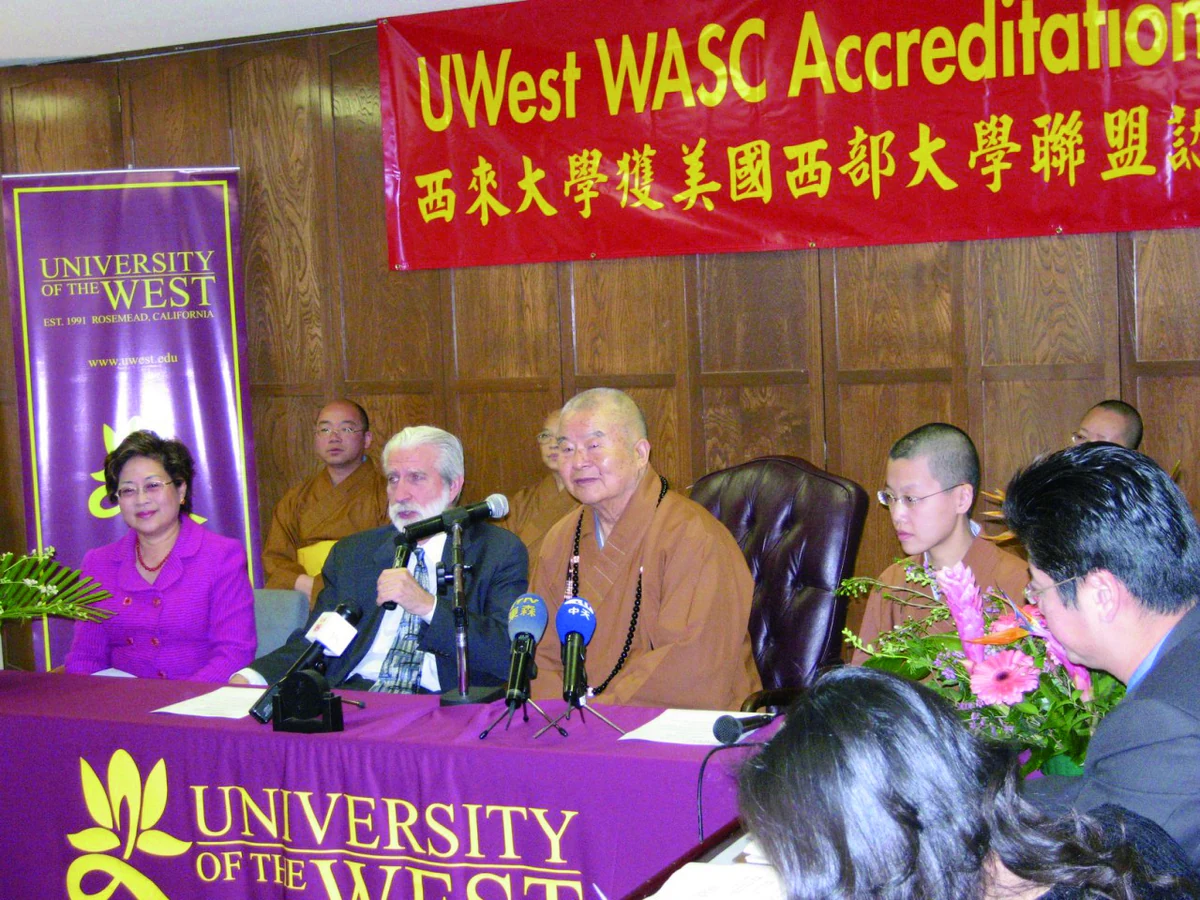
University of the West Receives WASC Accreditation

University of the West received Western Association of Schools and Colleges (WASC) committee accreditation, becoming a full member starting February 17, the first comprehensive higher education institution founded by Chinese in America. In the western United States, there are over 15,000 comprehensive universities with recognized credits and degrees, but not all schools have WASC accreditation. For the University of the West, founded in 1991, to obtain WASC accreditation is truly no easy feat. To rank among America's first-tier universities is the result of all Chinese people's efforts and an honor for all Chinese. It is also the achievement of successive presidents and staff members who gave their all.

Venerable Master Hsing Yun encouraged the entire school's faculty and students to continue striving, working hard to maintain this hard-won honor. He encouraged the school to develop with internationalization as its goal and refinement as its characteristic, creating a teaching environment where faculty and students are as close and mutually supportive as one family, becoming a first-class international institution.

March 4, 2006

Venerable Master Pioneers Conducting Triple Gem Refuge Taking Ceremony via Video Equipment

On March 4, 2006, Venerable Master Hsing Yun at Hsi Lai Temple, USA, pioneered conducting "Triple Gem Refuge Taking Ceremony" via video equipment.

Venerable Master travels around the world to propagate Dharma each year. During this period of teaching at University of the West in America, he presided over a refuge ceremony at devotees' request. Due to tight scheduling that made it impossible to visit everywhere, with the assistance of technical staff, the ceremony was conducted via remote video connection. Over 300 took refuge on-site, with simultaneous ceremonies connected to Vancouver, Brazil, New York, Boston, Houston, Fremont, and elsewhere, over 1,000 participating and observing. He also presided over tonsure ceremony for three Brazilian and Argentine disciples, writing a new record in Brazilian Buddhist history.

March 16, 2006

Receiving "Lifetime Achievement Award" and "Outstanding Achievement Award"

On March 16, 2006, Venerable Master Hsing Yun attended the "World Chinese Writers Association Sixth Congress" in Macau, receiving "Lifetime Achievement Award" and the Republican Party Asian Headquarters "Outstanding Achievement Award. Anna Chan Chennault and current Chairman Dr. Chen Pen-ch'ang on behalf of them President Bush, recognizing Venerable Master's contributions to cultural Dharma propagation. The award inscription read: "Venerable Master Hsing Yun's Meritorious Inscription for Promoting Humanistic Buddhism: 'Broadly giving and helping the multitudes, even Confucius would marvel; Propagating Dharma throughout the world, even Master Xuanzang could not achieve.

Secretary-General Fu Chao-hsiang, who served as a volunteer for World Chinese Writers Association for 25 years, stated that Venerable Master not only writes tirelessly but has always valued culture and enthusiastically supported literary and artistic activities, earning recognition from writers worldwide who unanimously agreed to present this award to Venerable Master. This is the first time in the World Chinese Writers Association's 25 years to present "Lifetime Achievement Award," Venerable Master truly deserves it. It is also the first time US Republican Party Asian Headquarters presented the award to an Asian Chinese, recognizing Venerable Master's dedication to world peace and humanitarian concern.

March 18, 2006

"To Enlighten Sentient Beings" Calligraphy Exhibition at Hunan Provincial Museum

On March 18, 2006, at invitation from Hunan Provincial Museum Director Chen Jianming, Venerable Master Hsing Yun attended the "To Enlighten Sentient Beings─Venerable Master Hsing Yun Calligraphy World Tour" opening ceremony. State Administration for Religious Affairs Director Ye Xiaowen, CPC Hunan Provincial Committee Secretary Xie Kangsheng, Taiwan Affairs Office of the State Council Deputy Director Wang Fuqing, Buddhist Association of China Executive Vice President Venerable Shenghui, and others jointly cut the ribbon. Over 800 attended; the exhibition lasted one month.

Venerable Master humbly said in his remarks that he is not skilled at Buddhist liturgical chanting, nor proficient in foreign languages, and especially has never practiced calligraphy, he cannot write calligraphy. Yet he had the opportunity to hold a calligraphy exhibition at Hunan Provincial Museum, a nationally designated key museum, proving that "all roads lead to Hunan." Venerable Master's humorous words drew enthusiastic applause and laughter from the attendees. After the exhibition concluded, it moved to Nanjing Museum on April 19 to continue exhibiting.

March 19, 2006

Speaking on "Chinese Culture and the Five Vehicle Buddhist Teachings" at Yuelu Academy

In March 2006, Venerable Master Hsing Yun was invited by Hunan Provincial Museum to preside over the "To Enlighten Sentient Beings—Venerable Master Hsing Yun Calligraphy World Tour" opening ceremony. Upon hearing the news, Yuelu Academy Dean Zhu Hanmin invited Venerable Master to hold a Buddhist forum at the academy's lecture hall on March 19.

Venerable Master spoke on "Chinese Culture and the Five Vehicle Buddhist Teachings," exploring the relationship between Buddhism and Chinese culture from four perspectives: "The Essence of Chinese Culture," "The Integration of Buddhism and Confucianism," "The Thought of the Five Vehicle Buddhist Teachings," and "The Future of Humanistic Buddhism," hoping the audience would understand the spiritual significance of Humanistic Buddhism through the essence of Chinese culture and the Five Vehicle Buddhist Teachings.

Dean Zhu Hanmin stated that Yuelu Academy has 1,030 years of history since beginning lectures in the Northern Song. On this millennia-old cultural lecture platform, countless cultural predecessors have held "truth-seeking" cultural gatherings. Having the opportunity to invite Venerable Master to lecture here created the first record of a monastic lecturing at this historic academy.

April 11, 2006

Bright Star, Luminous Cloud Book Launch

On April 11, 2006, Bright Star, Luminous Cloud written by Fu Chi-Ying was launched at Eslite Bookstore Xinyi Store. Venerable Master Hsing Yun attended with Global Views—Commonwealth Publishing Group founder Professor Charles Kao for dialogue. Cardinal Paul Shan Kuo-hsi, Tsai Sung-Lin, Fu Chi-Ying, and over 300 readers attended.

Venerable Master was born in an era of great social upheaval, enduring poverty and hardship, war and displacement, experiencing Buddhist discipline and political persecution. Though he weathered countless tribulations, endured setbacks, misunderstandings, and slander, through innate gifts and cultivated practice, he became a religious leader possessing "extraordinary comprehension, keen insight, strong persuasiveness, resolute execution, tremendous reach, and selfless vitality."

Professor Kao stated, "Venerable Master is a decisive, practicing religious reformer, a compassionate, popularizing creative master of Buddhist principles, and a philanthropic, knowledge-providing educator," truly no exaggeration.

Cardinal Paul Shan Kuo-hsi praised his old friend as not only a leader of the Buddhist community but a great figure of all authentic religions. His aspirations extend in all directions, his heart embraces the world, just like his Dharma name "Hsing Yun" (Star and Cloud), which represents the origins of the universe, vast and profound, boundless and infinite.

April 13, 2006

Venerable Master Attends First "World Buddhist Forum"

On April 13, 2006, Venerable Master Hsing Yun attended the first "World Buddhist Forum" held in Hangzhou. Venerable Master was one of the forum's eight initiators.

In early April, Venerable Master accidentally fell and broke three ribs. Though advanced in years, upholding the belief of "Never Make Any Returns," he followed the scheduled itinerary, attended the opening ceremony, and delivered the keynote address "How to Build a Harmonious Society," hoping to contribute to the beautiful vision of future harmony and integration among religions, cultures, and ethnicities. Over 1,200 eminent monks and virtuous teachers from around the world gathered for this grand assembly.

Note:
The 2nd World Buddhist Forum was jointly hosted by Buddhist communities across the strait and four regions, with Buddha's Light International Association as one of the organizers. Opening and closing ceremonies were held on March 29 and April 1, 2009, in Wuxi, Jiangsu and Taipei Arena respectively. Embodying principles of mutual respect and equality, it created history as the first cross-strait religious direct charter flight, advancing the progress of cross-strait and world peace.

April 20, 2006

Attending 23rd World Fellowship of Buddhists General Conference Joint Opening Ceremony at Fo Guang Shan

On April 20, 2006, Venerable Master Hsing Yun attended the joint opening ceremony of the 23rd "World Fellowship of Buddhists General Conference," 14th "World Fellowship of Buddhist Youth General Conference," and "World Buddhist University 6th Conference" held at Fo Guang Shan. Following the conference theme "Buddhism and Tolerance—Creating World Peace Together," he proposed four points:

1) Buddhism needs progress;
2) Buddhism needs enterprises;
3) Buddhism needs consensus;
4) Buddhism needs harmony.

Venerable Master stated that throughout the world, whether nations, humanity, or all professions and trades, everyone hopes to progress. Likewise, for Buddhism in this era, the most important thing is also to seek progress. When thinking becomes outdated, seek progress; when methods no longer apply, seek progress. Living in this world, those who know how to seek progress can develop forward; those who do not seek progress become outdated and are naturally eliminated. Humans walk on two feet, to take a step forward, one must leave behind the previous step. Similarly, as Buddhism has developed to the present, some old thoughts and systems must be abandoned, some must be revised and improved, and some should be vigorously promoted, so that Buddhism can continue to advance forward.

May 4, 2006

Venerable Master Receives "95th Year Honorary Literary and Arts Medal—Cultural Contribution Award" from Chinese Writer's & Artist's Association

On May 4, 2006, Venerable Master Hsing Yun received Chinese Writer's & Artist's Association "95th Year Honorary Literary and Arts Medal—Cultural Contribution Award"; Venerable Tzu Hui received the 47th "Literary and Arts Medal—Arts and Cultural Service Award." This was the first time in over 50 years the judging committee decided awardees would be religious figures.

Venerable Master stated that receiving the "Lifetime Achievement Award" from World Chinese Writers Association, "Outstanding Achievement Award" from US Republican Party Asian Headquarters, and "Cultural Contribution Award" from Chinese Writer's & Artist's Association, regarding these honors, he could not help but feel the blessings of the Triple Gem, the protection of devotees, the recognition and kindness of people from all quarters, and everyone's supportive conditions, which brought out his individual achievements.

May 24, 2006

"When Catholicism Meets Buddhism" Dialogue with Cardinal Paul Shan Kuo-Hsi at Fu Jen Catholic University

On May 24, 2006, Venerable Master Hsing Yun was invited to Fu Jen Catholic University for dialogue with Cardinal Paul Shan Kuo-hsi on "When Catholicism Meets Buddhism. The two engaged in discussion on three topics: "The Practice of University Religious Education: Promoting Religious Studies and Holistic Education," "The Practice of Social Service and Religious Education: On Service Learning," and "Interreligious Dialogue: On What Different Religions in Taiwan Can Learn from Each Other."

Venerable Master said Buddha's compassion is love; God loves humanity and is also love. Without love, society becomes chaotic. Cardinal Shan said God loves people; through people sharing love with others, caring for others, giving people hope and light. The strict education he received when ordaining as a monastic greatly influenced his character throughout his life.

Venerable Master firmly believes that as long as one establishes one's aspirations, life can be transformed.

Cardinal Shan, who has been in the Jesuit Order for exactly sixty years, stated that he grew up in a time of war and witnessed churches and church schools becoming shelters for people's body and mind. Thus he made a vow to become a priest, using the power of faith to transform people's hearts.

June 2006

Compiling Fo Guang Shan Monastics Handbook

Fo Guang Shan "leads through institution," establishing exemplary Buddhist institutional governance. In June 2006, marking the 40th anniversary of the mountain's founding, Fo Guang Shan Religious Affairs Committee compiled various regulations, titled Fo Guang Shan Monastics Handbook (later renamed Pure Regulations of Fo Guang Shan), enabling Fo Guang disciples to understand the transmission of tradition and monastic regulations, also including Venerable Master Hsing Yun's teaching quotations. The entire book emphasizes monastic regulations, carrying the profound meaning of "when the Sangha is pure and harmonious, Buddha-Dharma flows from distant sources."

Venerable Master stated that as Fo Guang Shan has developed, the number of people has grown increasingly larger, and units have multiplied accordingly. How to make Fo Guang Shan an organized, institutionalized Dharma propagation organization? It is necessary to establish regulations for monastics' daily life, practice, conduct, and systems, so that everyone follows them together, body and mind have standards to follow, and actions have guidelines to adhere to. Only then can the Sangha be harmonious, and only then can the true Dharma long abide, this is "when precepts abide, the Sangha abides; when the Sangha abides, the Dharma abides."

June 10, 2006

Speaking on "Harmony and Peace" at Stockholm University

On June 10, 2006, Venerable Master Hsing Yun was invited to Sweden's Stockholm University to deliver a lecture on "Harmony and Peace" for faculty, students, scholars, and the public. The university's renowned sinologist Professor Torbjörn Lodén delivered a welcome address, highly praising Venerable Master for spreading Humanistic Buddhism globally and making various contributions to world peace, especially through Buddhist cultural exchange to promote cross-strait peace, his achievements can be said to be outstanding.

With family harmony, people can be happy; when nations are peaceful, people can live in peace and abundance. Learning in daily life to achieve "exchanging positions with others, patience and yielding without contention, great compassion without conditions, and interconnected coexistence" enables them to move toward peace. He mentioned "treating enemies and loved ones equally, sharing prosperity and possessions, compassion without self, and equal respect," only by achieving these four points can they create peace for the world.

Venerable Master presented over 400 Buddhist books to Stockholm University including the Fo Guang Buddhist Canon: Chan Canon, Prajñā Canon, Pure Land Canon, Selected Chinese Buddhist Texts in Modern Language, and Collection of Contemporary Buddhist Works: Chinese Buddhist Academic Series, received by Professor Lodén on behalf of the university.

June 21, 2006

Meeting Pope Benedict XVI at St. Peter's Basilica

On June 21, 2006, Venerable Master Hsing Yun met with Pope Benedict XVI at the Vatican's St. Peter's Basilica. The Pope welcomed Venerable Master's delegation traveling from afar and stated he would pray for Taiwan's people, hoping to have the opportunity to meet with the people of Taiwan in the future.

Venerable Master presented the Pope with Cloud and Water, an image album of 50 years of propagation in Taiwan. Venerable Master stated he came to Rome in a pilgrimage spirit, also hoping to promote mutual understanding and cooperation between Buddhism and Catholicism.

Accompanied by ROC Ambassador to the Holy See, Vatican City Tou Chou-seng, Venerable Master also met at the Vatican with Pontifical Council for Interreligious Dialogue President Cardinal Paul Poupard, exchanging views on matters of mutual concern and cooperation.

Venerable Master has advocated for harmony and joy throughout his life, not only should Buddhist schools integrate with each other, but religions should also harmonize with one another. He has spared no effort in uniting with other religions to jointly promote world peace.

August 2006

Venerable Master Presides over Fo Guang University University: Status Unveiling Ceremony

In August 2006, Venerable Master Hsing Yun presided over "Fo Guang University" university-status unveiling ceremony and new president handover. National Cheng Kung University Emeritus Professor Weng Cheng-I assumed the presidency. President Weng stated he would do his utmost to lead Fo Guang University toward first-tier university status.

Weng Cheng-I said this is a rare affinity, not only can he serve Fo Guang University's faculty and students, but it is also an honor and a challenge. Having held administrative positions for many years, he originally intended to focus on teaching after retirement, but he could not resist Venerable Master's sincere invitation and thus agreed to assume the presidency. He expressed hope to return the college and department structure to a complete academic foundation, providing students with multifaceted learning opportunities, with the aspiration that all students at Fo Guang University can realize their potential.

August 8, 2006

Attending 3rd "Global Chinese Cultural Classics Reading Conference"

On August 8, 2006, Venerable Master Hsing Yun was invited to attend the 3rd "Global Chinese Cultural Classics Reading Conference" opening and "Global Reading Day" activity, announcing August 8 each year as Global Reading Day and explaining the significance of global classics reading for world peace. The activity connected live with tens of thousands of children reading classics at Nanjing Confucius Temple and Xi'an Great Wild Goose Pagoda, simultaneously reciting Chinese cultural classics together.

Venerable Master encouraged everyone to read beneficial classics, thoroughly understanding Chinese culture's precious classics and further promoting them. Venerable Master pointed out that a person must continuously seek opportunities for self-growth. One should not only read, but read beneficial books, and the classics are beneficial books. He hoped everyone would thoroughly study Chinese culture's precious classics, integrating and fully understanding the history, society, and humanities within Chinese culture.

October 14, 2006

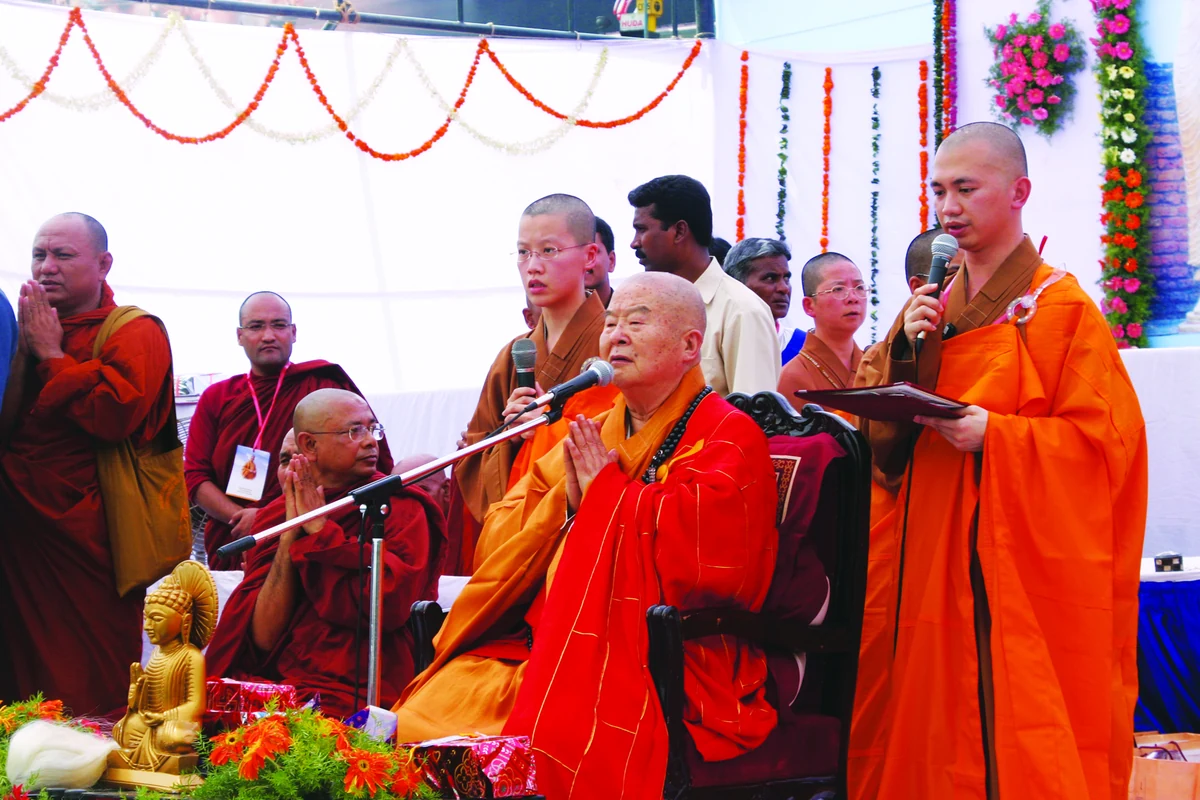
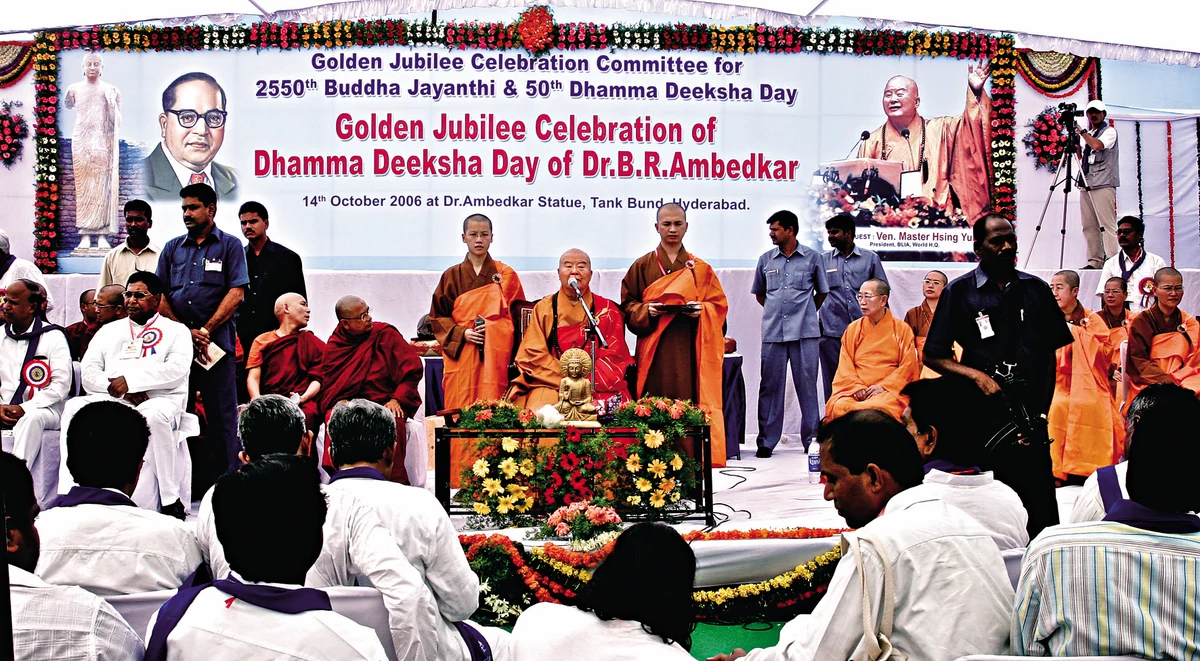
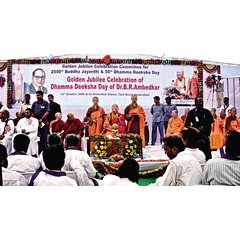
Presiding over 200,000-Person Triple Gem Refuge Ceremony in Hyderabad, India

On October 14, 2006, commemorating the 50th anniversary of Dr. B.R. Ambedkar, father of Indian Buddhist revival, leading 500,000 people to take refuge in Buddhism, Venerable Master Hsing Yun was invited to Andhra Pradesh's Hyderabad, India to preside over 200,000-person Triple Gem Refuge ceremony. Among the refuge-takers were over 20 government officials including Andhra Pradesh Home Minister K. Jana Reddy, former Governor Buta Singh, Tourism Director J. Geetha Reddy, as well as devotees from Kolkata and other parts of North India.

India gave birth to the Buddha who advocated equality, Nāgārjuna Bodhisattva who initiated Mahāyāna Buddhism, and Dr. Ambedkar who actively promoted the spirit of equality. For the future of Indian Buddhism, Venerable Master encouraged everyone to learn together the great spirit of Buddhas and bodhisattvas, and bravely step out of the shackles of the caste system. Buddhist disciples coming to India not only feel India's soil fragrant like flowers, but also that the Indian people's kindness and compassion are welcomed everywhere in the world. He hoped all refuge-takers would not only discover their inherent Buddha-nature, but also promote Buddhism's spirit of compassion, equality, and peace-loving, and furthermore live harmoniously with all of India and the entire world through respect, tolerance, joy, and harmony.

December 16-18, 2006

"2006 Venerable Master Hsing Yun Buddhist Lecture": 30 years at National Sun Yat-Sen Memorial Hall Completed

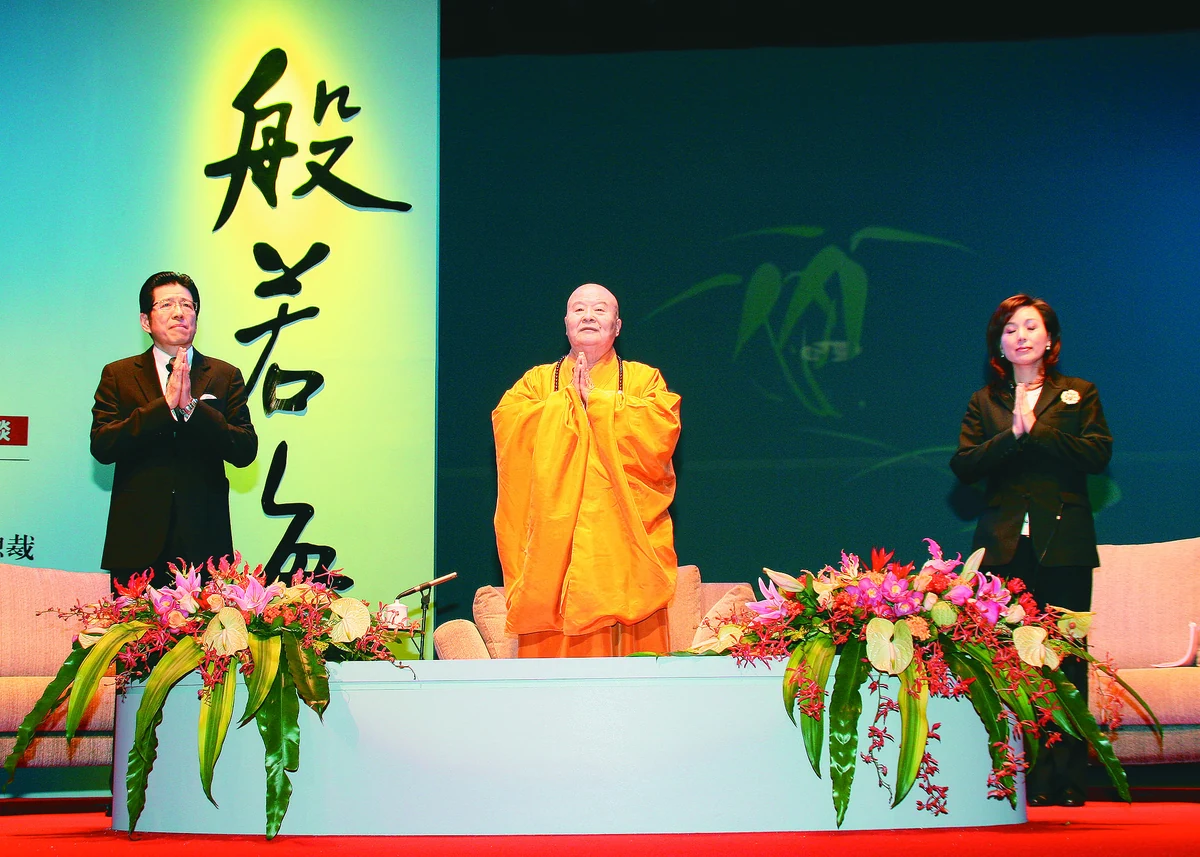
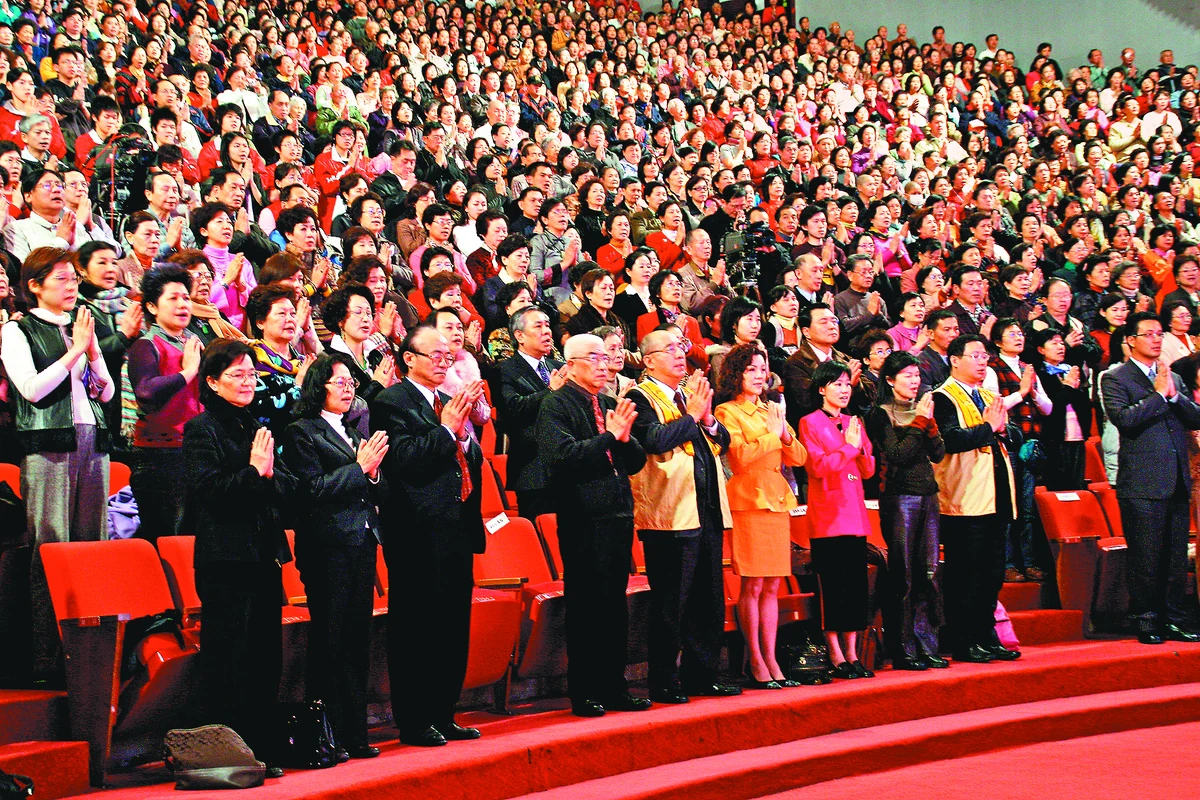
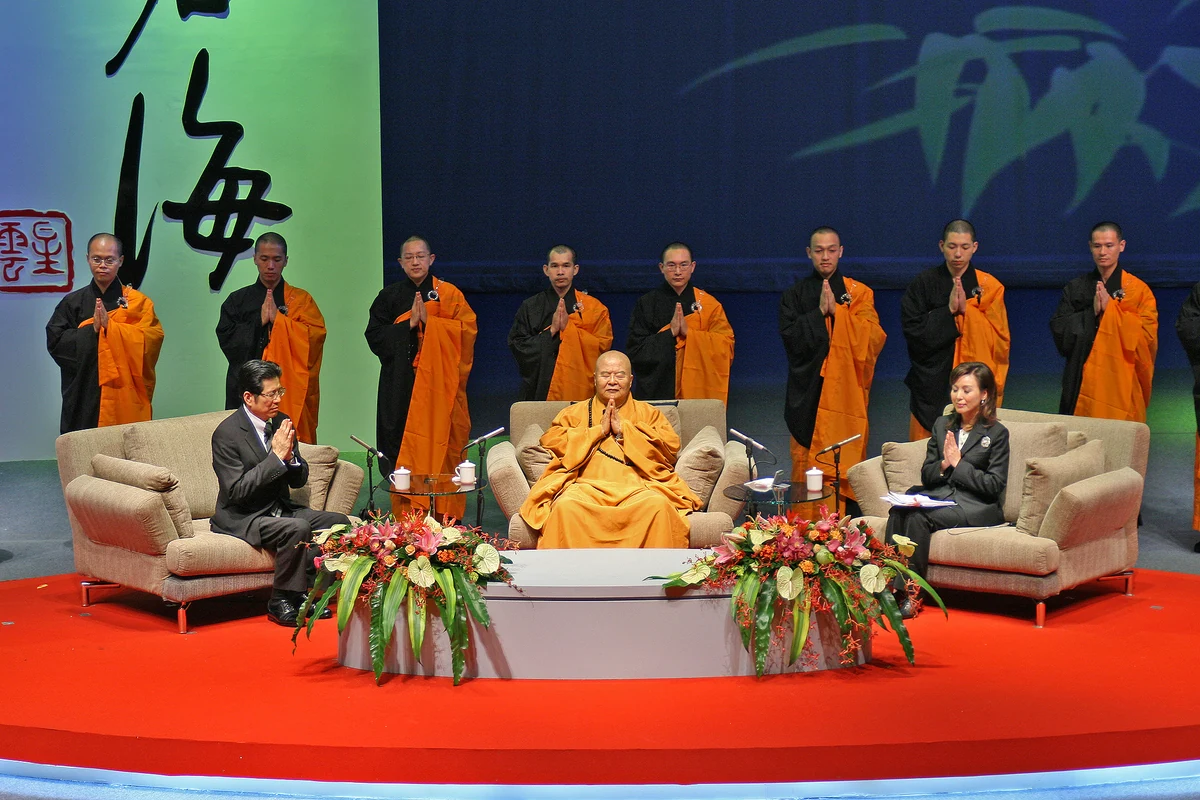
"2006 Venerable Master Hsing Yun Buddhist Lecture" marked Venerable Master completing 30 years at Taipei Sun Yat-sen Memorial Hall. Venerable Master dialogued with Landis Hotel Group President Stanley Yen, Catholic Cardinal Paul Shan Kuo-hsi, and Taipei Mayor Ma Ying-jeou on "Managing Things and People," "When Christ Meets Buddha," and "Harmonizing the Worldly and the Transcendent," with 30 locations worldwide sharing Dharma joy via simultaneous broadcast. The lectures were moderated by Professor Lee Chi-chu, Tsai Sung-Lin, Professor Charles Kao, and others, with Mr. Wu Po-hsiung as General Chairman.

In 1978, Venerable Master began holding the first "Buddhist Lecture" at Taipei Sun Yat-sen Memorial Hall. For thirty years uninterrupted, many people listened from youth to parenthood, following Venerable Master's propagation footsteps all along. Venerable Master lectured for 30 years, the public listened for 30 years, even the lecture emcee has been the same person for 30 years, never changed. For many people, persisting in one thing for 30 years is not easy; moreover, having a good reputation for 30 consecutive years is even harder, yet Venerable Master achieved all this.